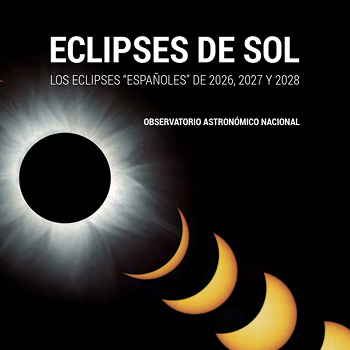
Due to its large size in the sky, the Sun, like the Moon, is one of the most irresistible celestial objects to photograph. For this reason, taking images of the Sun during an eclipse is particularly appealing. However, we must not forget the risks that this practice entails, both for people and for photographic equipment, and therefore extreme caution must be taken.
To photograph the Sun during an eclipse, it is recommended to use cameras that allow manual control of the different photographic parameters, such as exposure time, ISO and aperture. Commercial SLR cameras meet these requirements and, thanks to the wide range available and their versatility, have become an essential companion for this type of photography.
Despite being the largest object in the Solar System, its apparent size in the sky, due to the distance from the Earth, is similar to that of the full Moon. In order to obtain a reasonably large image of the Sun, the use of long focal length equipment, between 400 and 1,500 mm, is recommended. The longer the focal length, the larger the apparent size of the Sun will be, allowing more details to be seen, such as sunspots, provided that the appropriate equipment is used. The following table gives an idea of the size of the Sun’s image printed on 10 x 15 cm photographic paper for different focal lengths (equivalent to those of a 35 mm film SLR camera):
| Focal length (mm) | Diameter of the Sun (mm) | Sun size as a percentage of the photograph height (%) |
|---|---|---|
| 50 | 2 | 2 |
| 200 | 8 | 8 |
| 400 | 15 | 15 |
| 1.000 | 38 | 38 |
| 1.500 | 57 | 57 |
Very long focal lengths require bulky equipment, which is usually heavy. To prevent the photograph from becoming blurred due to camera movement when handheld, it is necessary to use a tripod to support the photographic equipment. It is always recommended to check the technical specifications of the selected tripod to ensure that it can support the weight of the complete setup, for example, the camera and lens. In addition, to avoid unwanted movement in photographs, the use of remote shutter releases is useful. Intervalometers or built-in camera functions can also be used. In this way, shooting sequences can be carried out without the need to press the camera shutter, allowing different phases of the eclipse to be captured.
Given the high brightness of the Sun, it is essential to use a strong solar filter in front of the camera lens. One of the most economical options is the use of a Mylar sheet, which must be placed over the lens aperture. With this accessory, the Sun can be photographed safely without saturating the image, obtaining a clear silhouette. Another option is to attach an H-alpha filter, which allows the Sun’s chromosphere to be photographed, making it possible to observe signs of activity such as solar flares. It should be noted that filters must be matched to the size of the lenses, and the use of adapters may be necessary. Even when using filters, it will likely be necessary to use low ISO sensitivity values, small apertures and short exposure times to prevent the photograph from becoming overexposed.
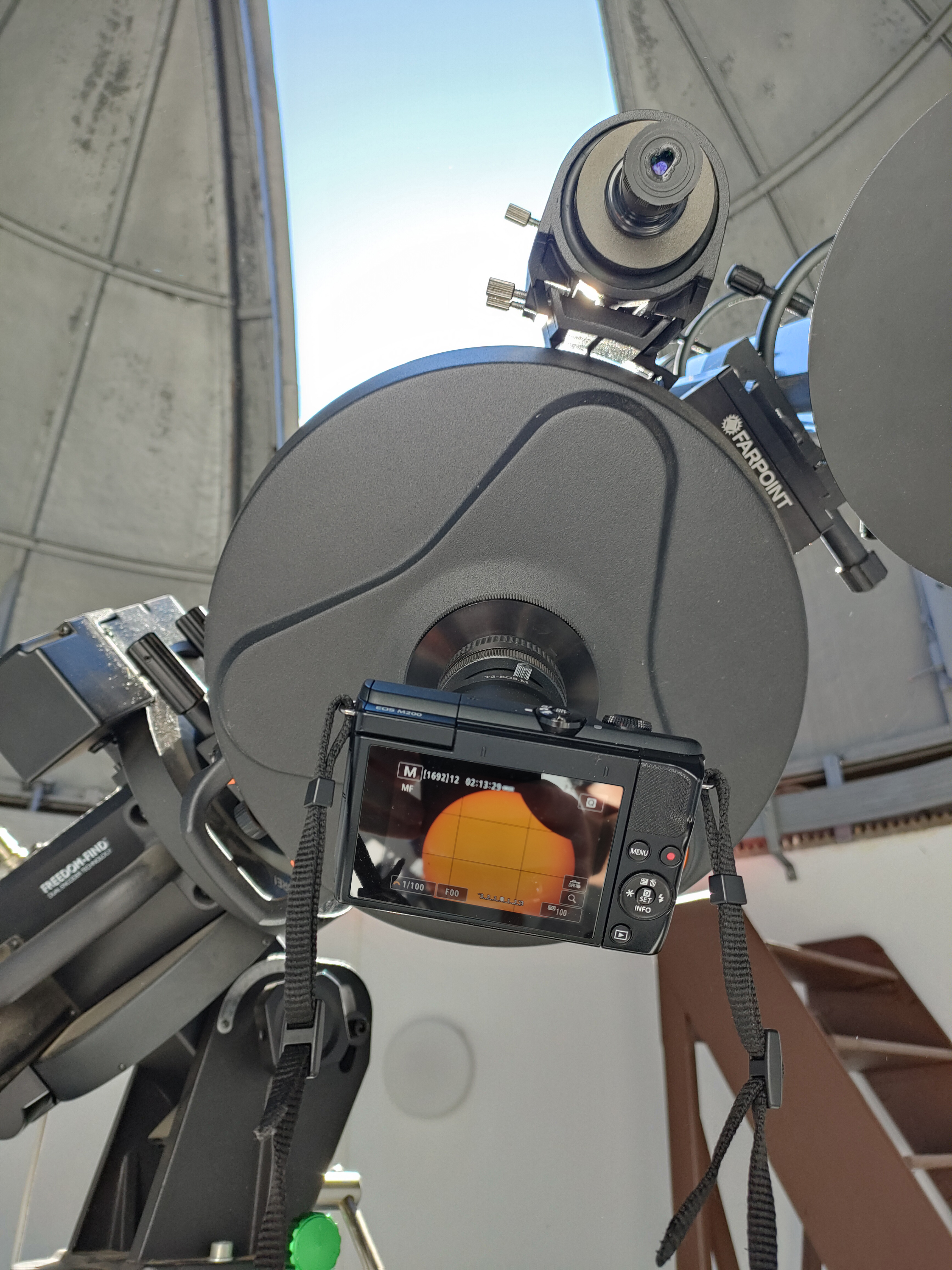
An option that can produce photographs with greater detail and quality, although it is also more complex, is the use of telescopes. In this case, the telescope tube takes on the role of a basic photographic lens, but with a very long focal length. Except in advanced equipment, this system requires manual focusing in order to obtain sharp images. The telescope mount may be motorised and, thanks to tracking, the Sun remains within the field of view, making it easier to capture shooting sequences. In this case, the use of filters such as those mentioned above is also essential. In addition, the camera is usually coupled to the telescope using an adapter, which depends on the model used.
Another option is to photograph the image of the Sun projected onto a screen. Photographs of the projection can be taken with no additional precautions beyond those required to project the Sun safely. The equipment needed for this option is less demanding, and images can be captured easily using the automatic mode of virtually any camera.
In all cases, it is advisable to check that the chosen strategy works properly by carrying out tests several weeks in advance, photographing the Sun under conditions similar to those expected at the time of the eclipse, using the same equipment that will be employed (same camera, same solar filter, same time of day, etc.). In addition, it is recommended to check that all equipment is in optimal condition, including batteries and accessories, and to pay special attention to the condition of the filters in order to avoid personal injury or damage to the equipment.