Eclipses Throughout History
Eclipses have deeply fascinated humankind since our most remote ancestors. They are astronomical phenomena that generate great anticipation, with people travelling long distances to observe them in the case of total or annular solar eclipses. Today we understand eclipses as cosmic shadow plays, the result of the celestial mechanics governing the motions of the Solar System. This has not always been the case, however: in the past, eclipses were regarded with fear and were often interpreted as ominous divine signs. In the following sections, we aim to document the strong influence that eclipses have exerted on humanity throughout history, from Antiquity to the 20th century.
Eclipses in Antiquity
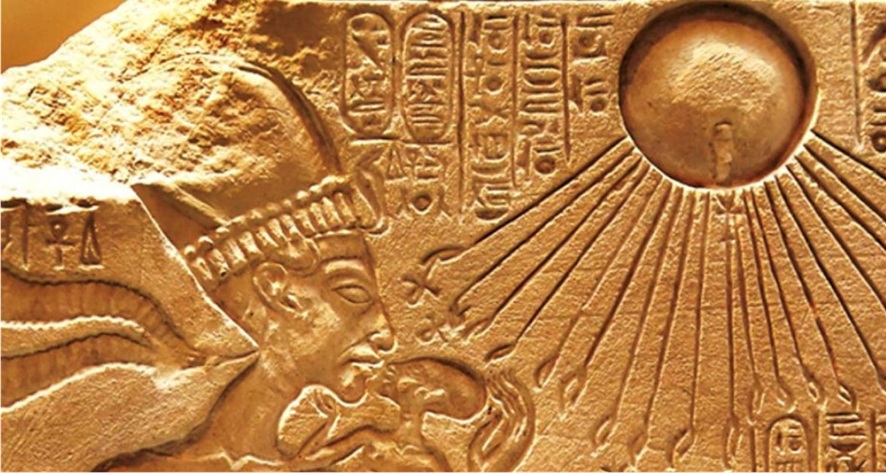
Curiously, there are very few written records of solar eclipses observed in Ancient Egypt. Modern calculations show that a considerable number of solar eclipses, including several annular and total ones, were visible from Egypt throughout its long history. This lack of records may be due to the superstition surrounding eclipses in the land of the pharaohs: Egyptians regarded eclipses as sources of misfortune, to the extent that merely speaking about them was believed to bring bad luck. It has been speculated that the dramatic change in state policy carried out by Amenhotep IV—who renamed himself Akhenaten, rapidly moved the capital from Thebes to Amarna, and established a monotheistic worship of Aten, the deity associated with the solar disc—may have been a consequence of a series of solar eclipses that occurred over Egypt in the 14th century BC. According to this hypothesis, these exceptional astronomical phenomena would have been interpreted as an unequivocal sign of the divine demanding a transformation in the organisation of the country.
In Mesopotamia, we find systematic records of the sky spanning several centuries. Among these records are numerous references to eclipses, which were interpreted astrologically as signs sent by the gods to the king and could be read as good omens if they were predicted in advance. Aided by the positional numeral system they developed, based on sexagesimal notation, Mesopotamian astronomers were able to identify favourable periods for the occurrence of eclipses at an early stage, several centuries before our era. Over time, Babylonian astronomers even succeeded in recognising finer patterns of repetition beyond the two annual eclipse seasons. The most famous of these repeating patterns is the Saros cycle (6,585.32 days), which they had already identified with certainty by the 3rd century BC.
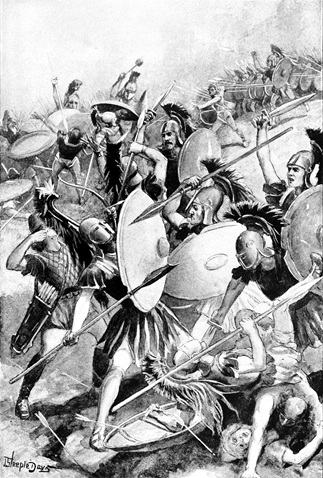
In 585 BC, a fierce battle was being fought on the Anatolian Peninsula. The opposing sides were the Medes and the Lydians, who had been at war for five years. Towards the end of the afternoon, a total solar eclipse plunged the battlefield into darkness and, according to the historian Herodotus, both sides interpreted it as an unequivocal sign of divine disapproval and hastened to sign a peace treaty. Modern calculations show that the eclipse indeed occurred on 28 May 585 BC and was total near the River Halys, where we believe the battle was taking place. As if this were not enough, Herodotus also states that the eclipse had been predicted by Thales of Miletus, an event often considered the first great predictive success of Western science. But could Thales really have predicted the eclipse?
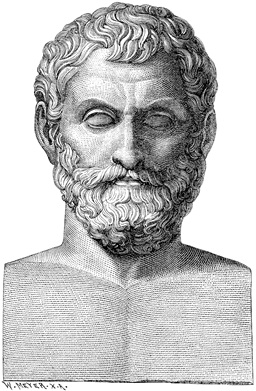
It has often been suggested that Thales may have learned from Babylonian astronomers how to predict eclipses using some recurring pattern, such as the Saros cycle. In Thales’s time, however, the Babylonians themselves were not yet able to predict solar eclipses with precision—a much more complex task than predicting lunar eclipses—nor had they recognised the Saros cycle, which would only be fully developed two or three centuries later. In any case, the Saros cycle is not particularly useful for predicting solar eclipses visible from a specific location, since there is a longitudinal shift of about 120° between successive eclipses. The accumulation of three Saros cycles (known as an exeligmos) does allow solar eclipses to be predicted for similar regions, but the eclipse of 585 BC occurred precisely at the edge of the path of totality, meaning that the eclipse preceding it by a triple Saros was not visible from the eastern Mediterranean. Thus, Thales could not have predicted the eclipse with certainty using such cycles. It is possible that he merely announced the possibility of an eclipse during an eclipse season, or that the prediction was attributed to him retrospectively, given his status as one of the Seven Sages of Antiquity.
In the context of the Peloponnesian War, in 413 BC, Athenian forces led by General Nicias were engaged with the enemy off the coast of Syracuse, in present-day Sicily—and matters were not going well for Nicias and his troops. When they were on the verge of retreating, on 27 August 413 BC, an astronomical phenomenon prompted a fatal change of plans. That night, the full Moon turned blood-red as a result of a total lunar eclipse. This terrified Nicias, who regarded it as an ill omen. Following the advice of his soothsayers, Nicias delayed departure for almost a month, giving the enemy a decisive advantage. The result was a crushing defeat for the Athenians, and Nicias was killed in the fighting; according to Thucydides, this was possibly the greatest defeat in the history of Hellenic warfare.
Eclipses in the Middle Ages and the Early Modern Period
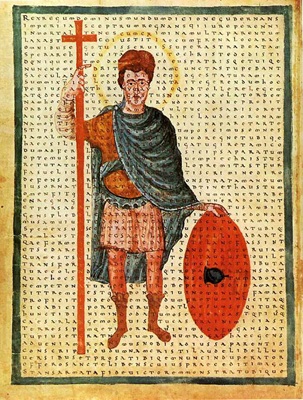
The 9th century opened with the coronation of Charlemagne as Emperor of what would become the Holy Roman Empire. Just fourteen years later, Charlemagne died after a series of solar and lunar eclipses visible from his realm, which were interpreted superstitionally. His son and successor, Louis the Pious, appears to have associated his father’s death with these eclipses. When a total solar eclipse occurred on 5 May 840, Louis the Pious clearly perceived it as a divine warning directed at himself. He was overwhelmed by fear and never recovered, believing that his days were numbered. He died one month later.
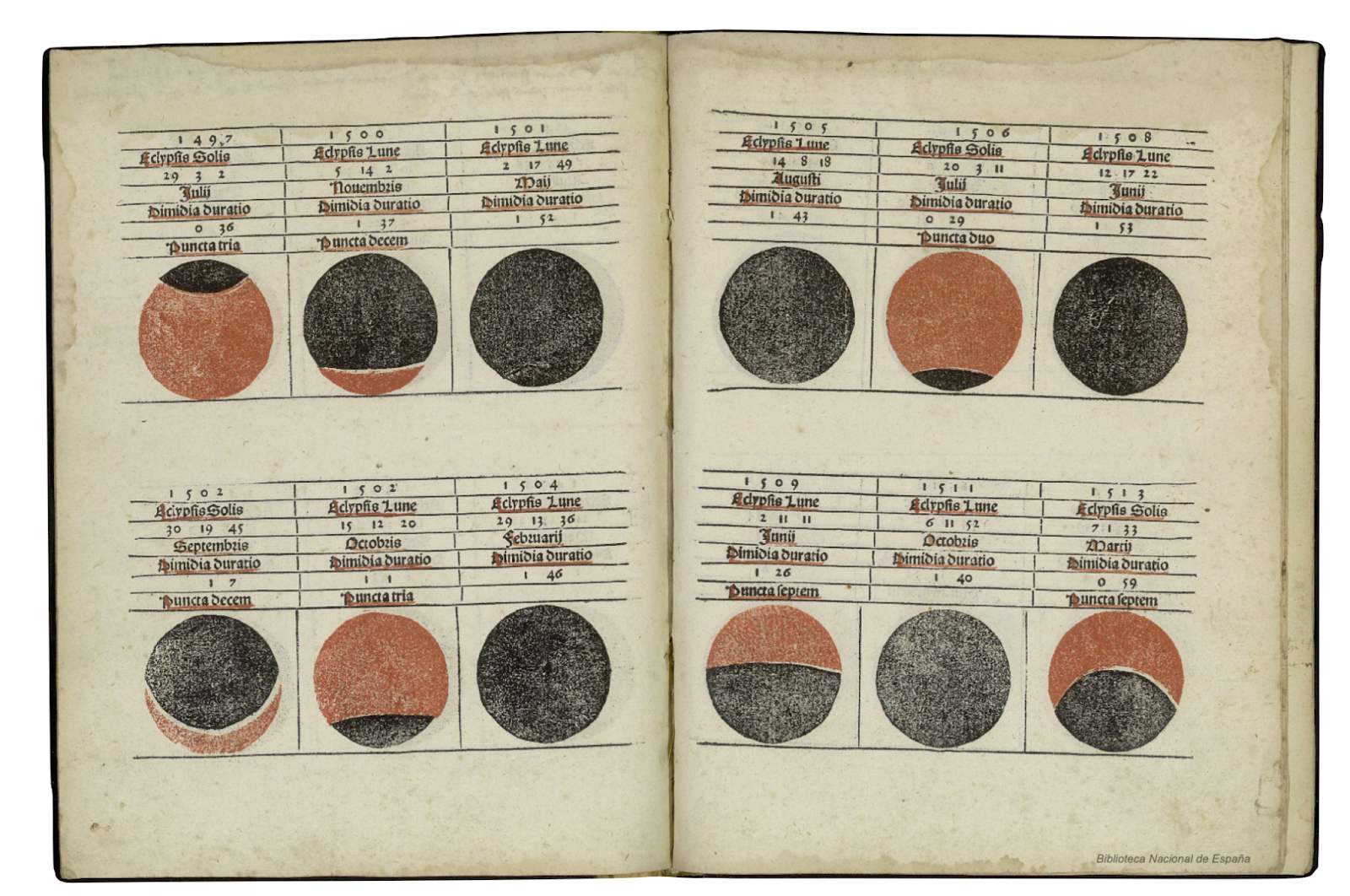
Eclipses can also be used for personal advantage. This was precisely what Christopher Columbus did when he encountered difficulties during his fourth voyage to the Americas. In 1503, after having to abandon two ships, his last pair of caravels became infested with marine worms, forcing him to anchor off the northern coast of Jamaica. Initially, the Jamaican natives were hospitable towards Columbus, but after six months without receiving anything in return, their patience and generosity began to wear thin. In desperation, Columbus consulted his Calendarium, a work of astronomical ephemerides by Regiomontanus. There he discovered that a total lunar eclipse would soon occur, on the evening of 29 February 1504. On that day, he invited the local chieftains aboard his flagship and explained that his powerful Christian God was deeply angered by their refusal to continue helping the Spaniards. As punishment, God would bring hunger and disease upon them, but he would give them one final chance: he would send a heavenly sign by darkening the Moon and, as a display of divine wrath, turning it red. If they changed their attitude after this warning, they could be spared.
Although the chieftains initially mocked Columbus, as the Moon rose above the horizon they began to notice something unusual. As the partial phase of the eclipse progressed, their mockery turned to fear, and they were utterly terrified when the Moon turned red. They hurried to Columbus to beg him to intercede with his God on their behalf. The navigator withdrew, and when the eclipse was about to end, he announced that his God had forgiven them, provided they pledged to assist the Spaniards. From that moment on, the Spaniards did not lack water or food during the time they were forced to remain in Jamaica.
Edmond Halley, discoverer of the famous comet that bears his name, was also one of the first astronomers in the Early Modern period to make accurate predictions regarding the visibility of solar eclipses. On 3 May 1715, he produced a detailed prediction of the path of an eclipse that would cross England from coast to coast, and he requested that citizens record the exact times at which the different phases of the eclipse began and ended. This constitutes one of the earliest examples of citizen science, aimed at refining the parameters of the orbits of the Moon and the Earth using observations of the same eclipse from multiple locations.
Antonio de Ulloa observes an eclipse at sea
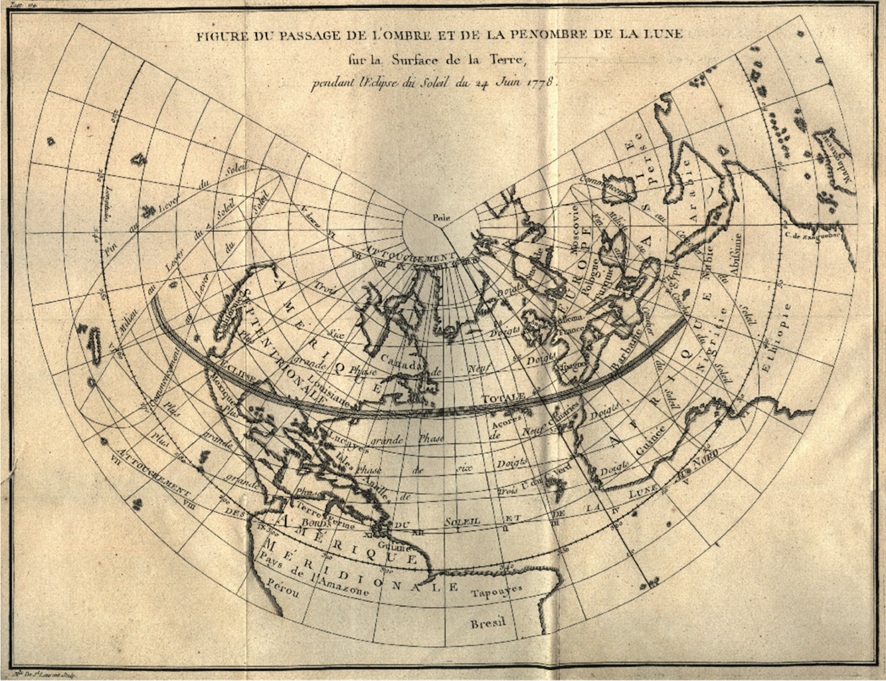
On 24 June 1778, a total solar eclipse occurred, whose path of totality crossed the Atlantic Ocean from one side to the other. Aboard the ship El España, Antonio de Ulloa was able to observe the totality of the eclipse and carry out several measurements. His aim was to calculate the longitude of Cape St Vincent by timing the contacts of the eclipse, but the limited instruments available to him prevented a precise result. The greatest interest of his observations lies in the fact that they include one of the earliest records of the solar corona, as well as the observation of a mysterious phenomenon: a bright point on the lunar surface.
Together with Jorge Juan, Antonio de Ulloa represents the archetype of the Enlightenment naval scientist. Both had taken part in the expedition to measure an arc of the meridian near the equator, which made it possible to deduce that the Earth is flattened at the poles. After several decades away from the sea, Ulloa requested to return to naval service and crossed the Atlantic aboard El España between 1776 and 1778. At the end of this campaign, while departing from Tenerife, the vessel found itself within the zone of totality of the solar eclipse on 24 June 1778. The timing and equipment available on board suggest that they had not actually planned to observe the eclipse.
Aware of the cartographic limitations of the era, Ulloa sought to take advantage of the opportunity to improve the determination of the geographical longitude of Cape St Vincent, which was not known with precision despite its naval importance. Although eclipses had been used to establish terrestrial coordinates, this method was poorly suited to use at sea. This difficulty was compounded by the poor quality of the available instruments: the crew had only nautical spotting scopes rather than equipment designed for astronomical observations; moreover, the ship’s timepieces lacked a seconds hand, and the only one that had one was broken, as Ulloa himself lamented. All of this, combined with a series of incorrect assumptions in his calculations, led Ulloa to an erroneous value for the longitude of Cape St Vincent.
During the four minutes of totality, Ulloa carried out one of the first scientifically documented observations of the solar corona. He described the details of this observation in a report submitted to King Charles III, in which he vividly recounted that most remarkable phenomenon, rarely observed even today: the luminous ring surrounding the lunar disc, a sight of extraordinary beauty. From this observation, Ulloa concluded that the Moon must possess an atmosphere similar to that of our planet. Although we now know this idea to be incorrect, Edmond Halley had reached a similar conclusion when observing a total solar eclipse at the beginning of the 18th century—a reasonable explanation given the scientific knowledge of the time. The vivid description of the colour and structure of the solar corona further suggests that the observations were made near a maximum of solar activity in 1778.
The Eddington eclipse
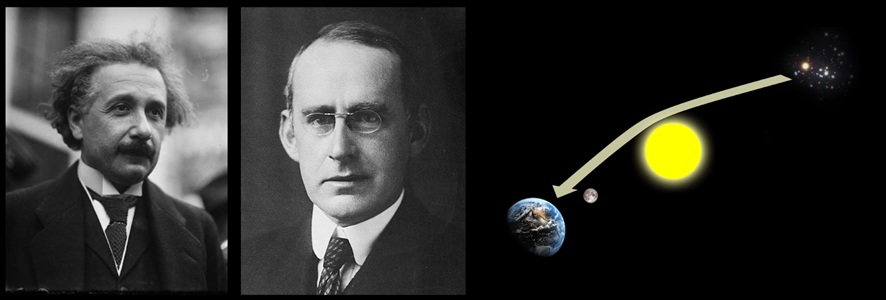
In 1915, Albert Einstein proposed one of the most influential theories of the 20th century, destined to shake the foundations of modern physics: the theory of general relativity. Among many other things, this theory makes a remarkable prediction: it tells us that mass deforms the space-time around it, so that the path of light is slightly curved as it passes near a massive body. This means that, in principle, we can observe an object located behind another one, provided that the intervening object has sufficient mass. The great British astrophysicist Sir Arthur Eddington, one of the brightest minds of his time, proposed that the theory of relativity could be tested empirically during a total solar eclipse. Indeed, by comparing the relative positions of a group of stars close to the solar limb before and during the eclipse, it would be possible to determine whether the Sun’s mass was distorting the trajectories of the light rays coming from distant stars.
The deflections predicted were extremely small, comparable to observing the thickness of a pin from a distance of about 200 metres. Despite this, Eddington embarked on the endeavour equipped with the finest instruments of the time, determined to observe the total solar eclipse of 29 May 1919. It was an eclipse with a long phase of totality and, moreover, the Sun passed close to the Hyades star cluster in the constellation Taurus. This provided a significant number of point-like stars that could serve as reliable reference points for comparison. In order to test whether Einstein was correct, the British organised a dual expedition: one group, led by Eddington himself, travelled to the island of Príncipe off the coast of Africa, while a second group was sent to observe the eclipse from Sobral, in north-eastern Brazil.
Using photographic plates, both teams recorded the positions of the stars during the eclipse and again several months later, at night. By comparing these observations, Eddington demonstrated that the positions of the stars shifted slightly during the eclipse, exactly as expected if the Sun’s gravity modifies the surrounding space-time, deflecting the light from distant stars. Since then, numerous additional experiments using increasingly precise instruments have confirmed this effect in full agreement with the general theory of relativity.
Spanish eclipses in the 20th century
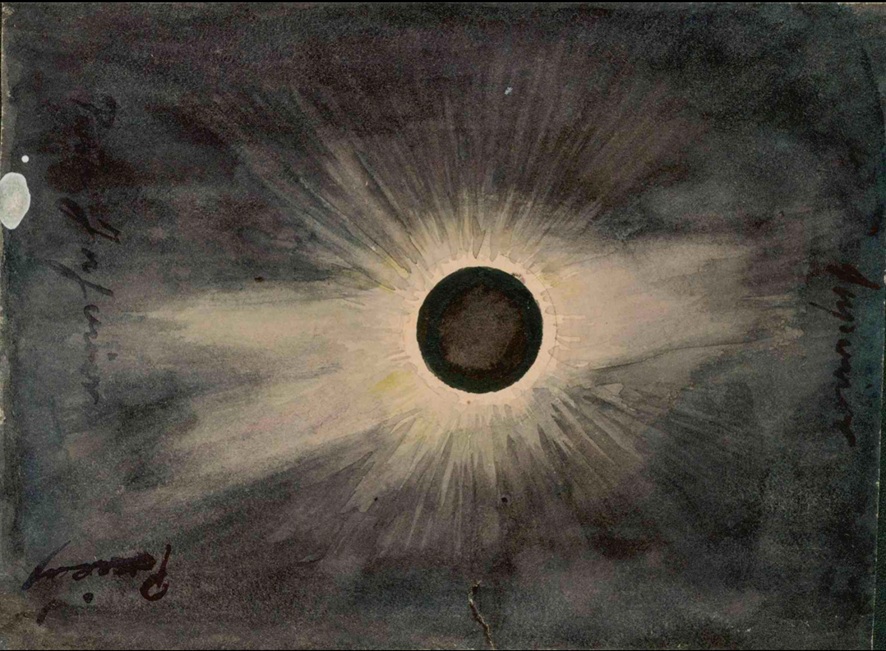
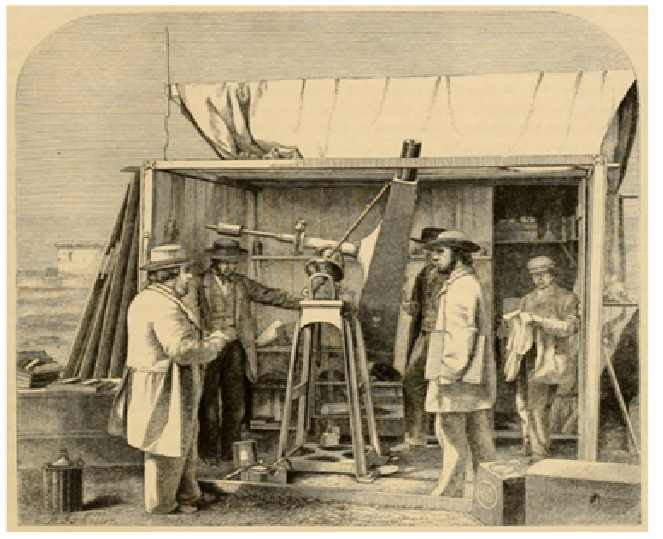
During the second half of the 19th century, Spain had already been fortunate enough to witness two total solar eclipses, in 1860 and 1870. These events prompted scientific expeditions and led to some of the earliest studies in solar coronal astrophotography. Warren de la Rue himself travelled to Álava to observe and photograph the first of these eclipses. There, a very young Santiago Ramón y Cajal—later to become a Nobel Prize winner in Medicine—was deeply affected by witnessing this astronomical phenomenon at just eight years of age.
After the rehearsal provided by these two 19th-century eclipses, the ground was prepared to receive a trio of solar eclipses visible from the Iberian Peninsula at the beginning of the 20th century. The first took place on 28 May 1900, and several Spanish teams travelled to observe it: staff from the San Fernando Observatory went to Elche, while astronomers from the Madrid Observatory observed the eclipse from Plasencia. It should be noted that, strictly speaking, the 20th century begins in 1901, but for historical reasons the eclipse of 1900 is included within this group.
The director of the Madrid Observatory had insisted on the need to acquire advanced telescopes in order to be on a par with the international expeditions arriving in Spain. As a result, funding was obtained to purchase two 20 cm aperture telescopes from the prestigious Grubb company in Dublin. To the astronomers’ frustration, the procurement and payment process was delayed, and the instruments arrived at the chosen observation site only eleven days before the eclipse. Transporting them was no easy task either: according to accounts, the telescopes were delivered on ox-drawn carts—a picturesque detail that contrasts with the advanced technology they embodied.
Fortunately, the astronomers were able to observe the eclipse successfully using the excellent Grubb telescopes—one visual and one photographic—from El Berrocalillo, near Plasencia. The observation was an international collaboration: the Spanish team, led by Director Íñiguez, worked alongside prominent Irish astronomers, including Sir Howard Grubb himself, the telescope maker. The observing programme pursued three key objectives: precise timing of the eclipse contacts, photography of the solar corona, and spectral analysis to study the mysterious green emission line, an enigmatic feature at the time. This first eclipse not only marked a scientific milestone, but also symbolised the drive towards modernisation and recognition of astronomy in Spain.
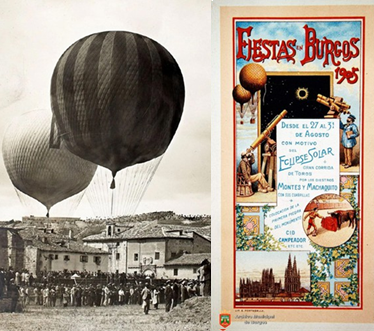
On 30 August 1905, a second total solar eclipse visited Spain, this time with a maximum duration of almost four minutes. The country became the epicentre of the phenomenon, attracting more than twenty international scientific teams. Burgos, with its clear skies and strategic location, was selected as the main observation site by the Madrid Observatory. Temporary facilities were erected for national and foreign astronomers, and the army was involved in logistical support. Teams employed cameras, spectrographs and polarimeters to study the solar corona and other astronomical details. Particularly noteworthy was a pioneering attempt to observe the eclipse from hot-air balloons, an idea promoted by the Ministry of War, which set an important precedent in atmospheric and space studies.
The eclipse of 1905 was not only a scientific event, but also a cultural phenomenon. Thousands of spectators travelled to Burgos, overcrowding trains and filling the streets. King Alfonso XIII, accompanied by members of the royal family and government, visited the facilities and attended the balloon launches. Meanwhile, the city hosted festivals, theatrical performances, bullfights and even organised a photographic competition dedicated to the eclipse. Astronomers from the San Fernando Observatory also travelled to Castile, observing the eclipse from Soria, while observations were also carried out from institutions such as the Cartuja Observatory, the Ebro Observatory and the Fabra Observatory.
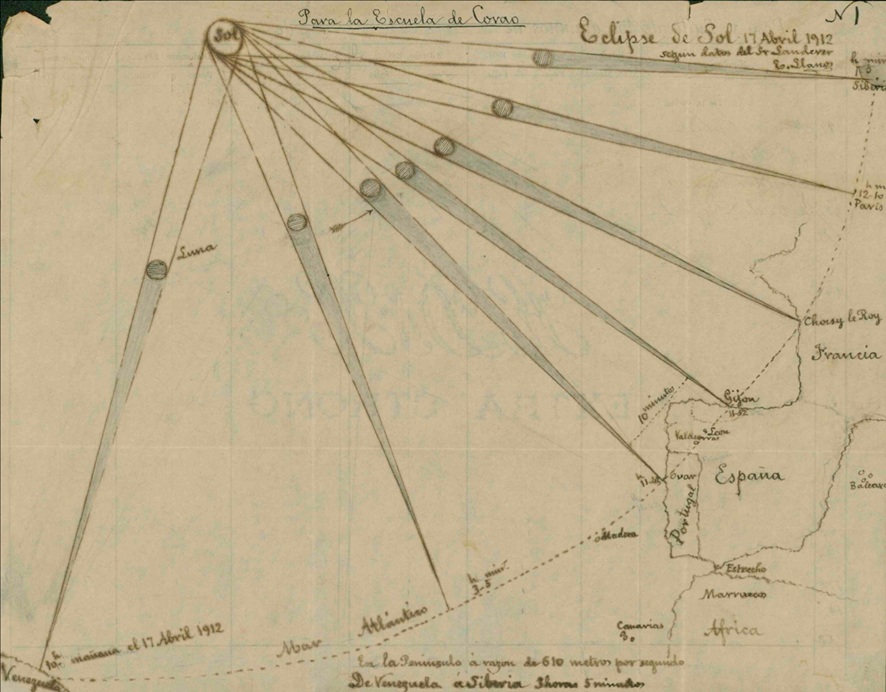
The eclipse of 17 April 1912 had a particularly distinctive feature: calculations indicated that it would be total for only a few seconds along a narrow strip in the north-west of the Iberian Peninsula, while appearing annular along the rest of its path. This is what is known as a hybrid eclipse. However, there was a possibility that the event would be perceived as purely annular across the entire peninsula due to uncertainties in the calculations, which depend on the Moon’s orbital motion. This uncertainty underscored the importance of accurately measuring the duration of totality.
Preparations began a year in advance, with expeditions to determine the most suitable observation sites. Ultimately, the Royal Astronomical Observatory of Madrid selected Cacabelos, in León, as the optimal location. Preliminary campaigns included precise coordinate measurements and studies of local terrain conditions. The critical phase of the eclipse lasted barely seven seconds, during which the famous Baily’s beads could be observed—bright flashes produced by irregularities along the lunar limb. These observations led to several scientific publications by both Spanish and foreign teams. School teachers also made great efforts to promote eclipse observation among pupils and local residents.
Film history is usually considered to begin in 1895 with the first public screening by the Lumière brothers in Paris. Just ten years later, Josep Comas Solà, director of the Fabra Observatory in Barcelona, attempted to record the 1905 eclipse on film but encountered technical problems. For the 1912 eclipse, Comas Solà travelled to Barco de Valdeorras, in Galicia, to film the event using a movie camera supplied by the Pathé company. Using two prisms, he succeeded in recording the flash spectrum of the eclipse—the emission spectrum of the chromosphere visible briefly during totality. He also confirmed that although the eclipse appeared total to the naked eye, the film showed that it was not fully so, leading him to conclude that the path of totality passed a few kilometres south of his position, in agreement with modern calculations.
Despite the differences between the eclipses of 1900, 1905 and 1912, these events shared several key elements: significant scientific advances, international cooperation, logistical challenges and a strong social impact. Thanks to this trio of eclipses, astronomy in Spain experienced a period of growth and innovation at the beginning of the 20th century. In the third decade of the 21st century, Spain once again finds itself at the centre of a series of solar eclipses that will undoubtedly attract considerable international attention.
The eclipses of 1860 and 1870
During the second half of the 19th century, Spain had already been fortunate enough to witness two total solar eclipses, in 1860 and 1870. These eclipses prompted scientific expeditions to observe them and led to some of the earliest studies in solar coronal astrophotography. Warren de la Rue himself travelled to Álava to observe and photograph the first of these eclipses. There, a very young Santiago Ramón y Cajal—later to become a Nobel Prize winner in Medicine—was deeply affected by witnessing this astronomical phenomenon at just eight years of age.
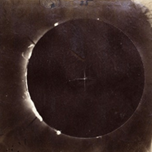
The eclipse of 1860, and the observations carried out by de la Rue from Spain, were fundamental in revealing the origin of solar prominences. These flame-like structures, which form intricate loops around the Sun, are visible during total solar eclipses, when the Moon blocks the photosphere. However, in the mid‑19th century it was not clear whether these tentacle-like features were intrinsically part of the Sun, or instead characteristics of the Moon or phenomena associated with the Earth’s atmosphere. Warren de la Rue captured the total phase of the eclipse using his photoheliograph from two different locations. If the prominences originated on the Earth or the Moon, they would appear differently from each site; if they were part of the Sun, they should coincide. De la Rue observed that the prominences were identical in both photographs, thus demonstrating that they were indeed part of the Sun—structures in the atmosphere of our star that are normally invisible due to the brightness of the solar disc.
The total solar eclipse of 1900
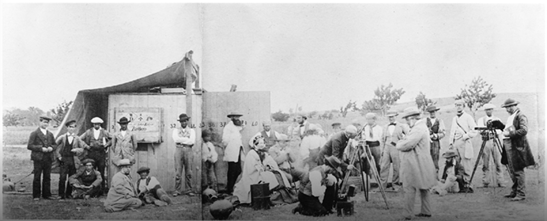
After the general rehearsal provided by these two nineteenth-century eclipses, the stage was set for a trio of solar eclipses that would be visible from the Iberian Peninsula at the beginning of the twentieth century. The first of these took place on 28 May 1900, and several national teams travelled to observe it: astronomers from the San Fernando Observatory went to Elche, while those from the Madrid Observatory observed the eclipse from Plasencia. It should be clarified that, technically, the twentieth century began in 1901, but for historical reasons we include the 1900 eclipse among the group of eclipses of that century.
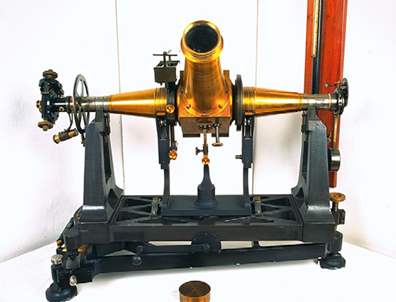
The director of the Madrid Observatory had insisted on the need to acquire advanced telescopes in order to be on a par with the international expeditions that would be arriving in Spain, and they therefore secured funding to purchase two telescopes with an aperture of 20 cm from the prestigious Grubb firm of Dublin. To the astronomers’ despair, the process of acquiring and paying for the telescopes dragged on; the instruments arrived at the chosen observation site just 11 days before the eclipse. Transporting them was no easy matter either: according to accounts, the telescopes arrived in “ox-drawn carts”, a picturesque detail that contrasts sharply with the advanced technology represented by the instruments.
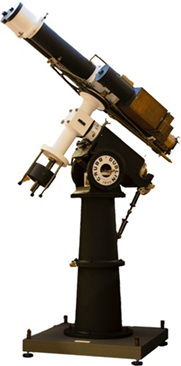
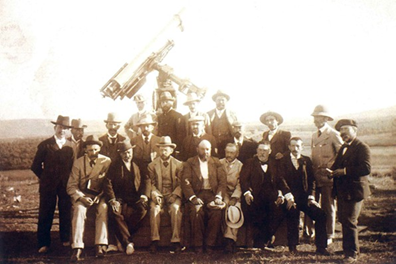
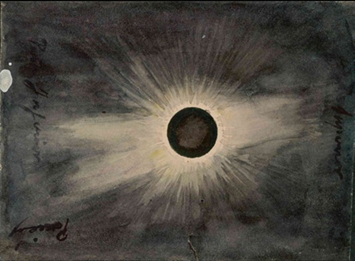
Fortunately, the astronomers were able to observe the eclipse using the excellent Grubb telescopes, one optical and the other photographic, from El Berrocalillo, near Plasencia. The observation was an international collaboration: the Spanish team, led by Director Íñiguez, worked alongside leading Irish astronomers, including Sir Howard Grubb himself, the manufacturer of the telescopes. The observation programme pursued three key objectives: to measure the eclipse contacts with precision, to photograph the solar corona, and to analyse its spectrum in order to study the mysterious “green line”, a spectral feature that was enigmatic at the time. This first eclipse not only marked a scientific milestone, but also symbolised the struggle for the modernisation and recognition of astronomy in Spain.
The total solar eclipse of 1905
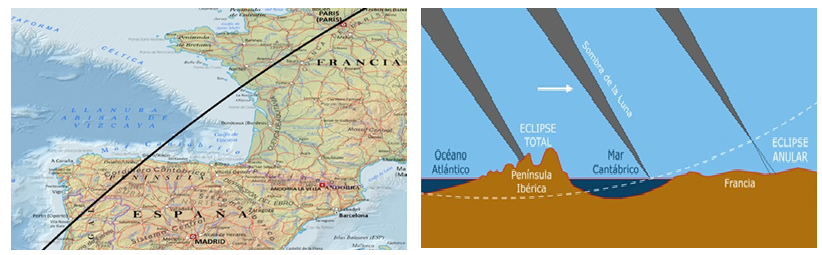
On 30 August 1905, a second total solar eclipse visited Spain, this time with a maximum duration of almost four minutes. Our country became the epicentre of the phenomenon, attracting more than twenty international teams of scientists. There were two circumstances that made the eclipse particularly interesting: on the one hand, it would be visible from three continents (America, Europe and Africa) and, on the other, it was an exceptionally long eclipse. Specifically, the point of maximum eclipse, where totality lasts longest, occurred over Spain, which is why the event became known as “the Spanish eclipse”. The path of totality across the Iberian Peninsula was very similar to that of the total solar eclipse of 12 August 2026.
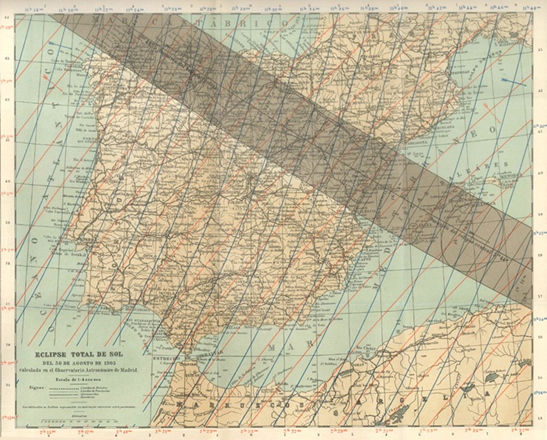
Burgos, with its clear skies and strategic location, was selected as the main observation site by the Madrid Observatory. Temporary facilities were set up there for both national and foreign astronomers, with the army also involved in logistical tasks. The teams used cameras, spectrographs and polarimeters to study the solar corona and other astronomical details. Also noteworthy was the pioneering attempt to conduct observations from hot-air balloons, an idea promoted by the Ministry of War, which set a precedent in the field of space studies.
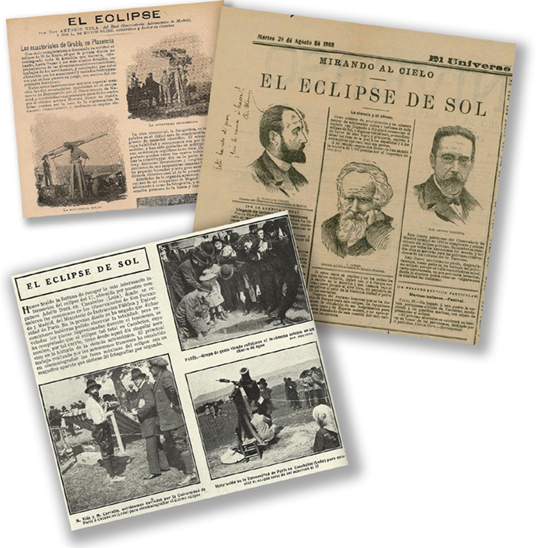
The 1905 eclipse was not only a scientific event, but also a cultural phenomenon. Thousands of curious onlookers travelled to Burgos, crowding trains and filling the streets. King Alfonso XIII, accompanied by members of the royal family and the government, visited the installations and attended the balloon launches. Meanwhile, the city was festooned with festivals, theatrical performances and bullfights, and even a photographic competition of the eclipse was organised. Astronomers from the San Fernando Observatory travelled to Castile to observe it, in their case from Soria. In addition, observations of the eclipse were made from centres such as the observatories of La Cartuja, the Ebro and Fabra.
The hybrid solar eclipse of 1912
The eclipse of 17 April 1912 had a feature that made it particularly special: calculations indicated that it would be total for only a few seconds along a narrow strip of the north-west of the Iberian Peninsula, while for the rest of its path it would be annular. This is what is known as a hybrid eclipse. However, there was a possibility that across the entire Peninsula the phenomenon would be perceived only as annular, due to the uncertainty associated with the calculations, whose details depend on the Moon’s orbital motions. Hence the importance of measuring the duration of totality with precision.
Preparations began a year earlier, with expeditions to determine the best locations from which to observe the phenomenon. Eventually, the Royal Astronomical Observatory of Madrid chose Cacabelos, in León, as the optimal site. Preliminary campaigns included precise coordinate measurements and studies of ground conditions. The critical phase of the eclipse lasted barely seven seconds, during which the famous “Baily’s beads” could be observed—bright flashes formed by irregularities along the lunar limb. This led to several scientific publications by both Spanish and foreign teams. Schoolteachers also worked diligently to encourage the observation of the eclipse among pupils and local inhabitants.
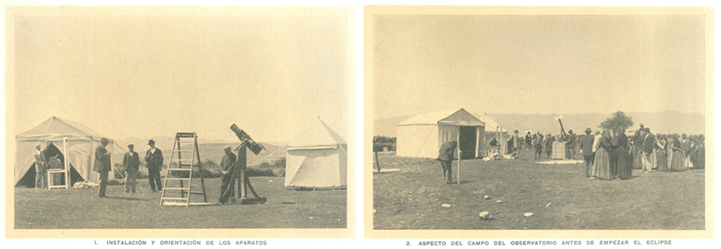
It is usually considered that the history of cinema began in 1895 with the first public film screening by the Lumière brothers in Paris. Barely ten years later, Josep Comas Solà, director of the Fabra Observatory in Barcelona, attempted to make a cinematographic recording during the 1905 eclipse, but encountered technical difficulties. For the 1912 eclipse, Comas Solà travelled to Barco de Valdeorras, in Galicia, to record the astronomical phenomenon using a motion-picture camera provided by the Pathé company. In this way, and through the use of two prisms, the astronomer was able to obtain a recording of the eclipse’s flash spectrum, the emission spectrum of the chromosphere that is briefly visible during totality. Moreover, he was able to confirm that, although to the naked eye the eclipse appeared to be total momentarily, the film shows that it was not, leading him to conclude that the path of totality must have passed a few kilometres to the south of his position—an assessment that coincides with modern calculations.
Despite the differences between the eclipses of 1900, 1905 and 1912, these events shared several key elements: significant scientific advances, international cooperation, logistical challenges and a notable social impact. Thanks to this trio of eclipses, astronomy in Spain experienced a period of growth and innovation in the early twentieth century. In the third decade of the twenty-first century, Spain is once again the setting for a series of solar eclipses that will undoubtedly attract considerable international attention.
Spain: from the year 1000 to 2005
Discover in this volume, written by Manuel Vázquez Abeledo (3 January 2025), one of the country’s most distinguished solar physicists, a chronological account of the eclipses that have been visible from Spain from the year 1000 to 2005. Download this book as a free PDF.