As with any other astronomical phenomenon, meteorological conditions are crucial for observing eclipses. The presence of cloud cover or fog may prevent them from being visible, especially if they occur close to the horizon, as is the case with the eclipses of 2026 and 2028.
Although Spain is popularly considered a sunny country, its meteorology is complex and is influenced by orography, vegetation and prevailing winds. Below are some comments on the average climatic conditions in the regions within the path of totality on the days of the eclipses. This should not be taken as a weather forecast, as such forecasts cannot be made so far in advance, but rather as guidance on what we are most likely to encounter on those dates. The State Meteorological Agency (AEMET, https://www.aemet.es) provides accurate weather forecasts several days in advance. It is advisable to consult these forecasts in the days leading up to the event to determine whether the observation location will have favourable sky conditions.
Eclipse of 12 August 2026
The path of totality will enter the north-west of the Iberian Peninsula and move towards the east coast, also covering the Balearic Islands. The figure below shows the frequency of partly cloudy or clear skies during the dates and times around the eclipse, based on data collected by AEMET over the last sixteen years.
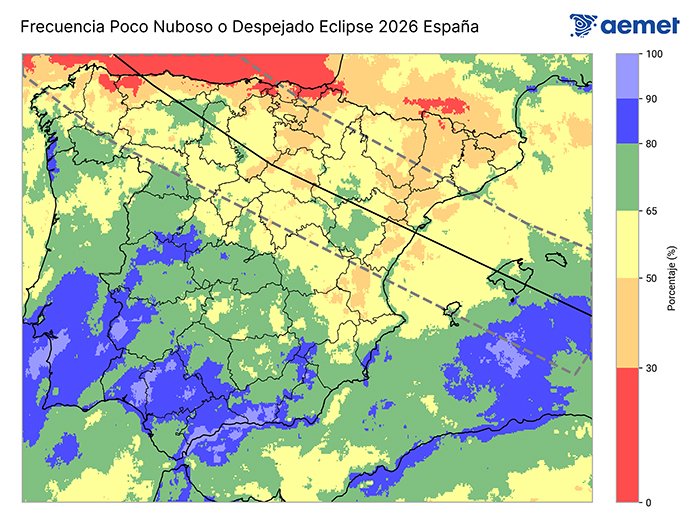
Warm colours (reds, oranges and yellows) indicate a lower probability of clear skies, whilst cool tones (blues and greens) represent a higher frequency of conditions favourable for observation. As can be seen, there tends to be more cloud cover in the areas along the Cantabrian coast, with a probability of clear skies of around 30–50%. Mountain ranges such as the Cantabrian Mountains themselves, the Iberian System and the Central System also tend to produce convective cloud cover, as they lift the air and cause the moisture it carries to condense as it cools. Vegetation also plays a role in the weather, as forested areas absorb the Sun’s heat, also causing the formation of convective clouds when atmospheric conditions permit. Conversely, the southern half of the Peninsula generally has the highest frequency of clear skies, although it lies outside the path of totality for the eclipse. Inland on the peninsula, including large areas of Castile and León, Castile-La Mancha and the Ebro Valley, conditions are also likely to be favourable, with a moderate to high probability of partly cloudy or clear skies.
However, it should be noted that this analysis serves solely as a statistical reference and does not constitute a weather forecast for the day of the eclipse; therefore, the actual weather conditions on that day can only be determined with sufficient accuracy in the days leading up to the event.
Eclipse of 2 August 2027
The path of totality for this eclipse will pass through the extreme south of the Peninsula and North Africa. In Spain it will therefore be visible from Ceuta and Melilla, much of the province of Cádiz, a large part of the province of Málaga, and the southern areas of the provinces of Granada and Almería. As shown in Figure 2, these are regions with a low probability of cloud cover, although it is slightly higher in western Cádiz due to the ingress of humid air from the Atlantic. The maximum of the eclipse will occur at around 11 a.m., when the Sun will be quite high in the sky, making observation easier.
Eclipse of 26 January 2028
The path of annularity for this eclipse will cross the Peninsula from south-west to north-east and will also be visible in the Balearic Islands. It will occur close to the horizon and in winter, so the meteorological conditions typical of the season may hinder its observation.
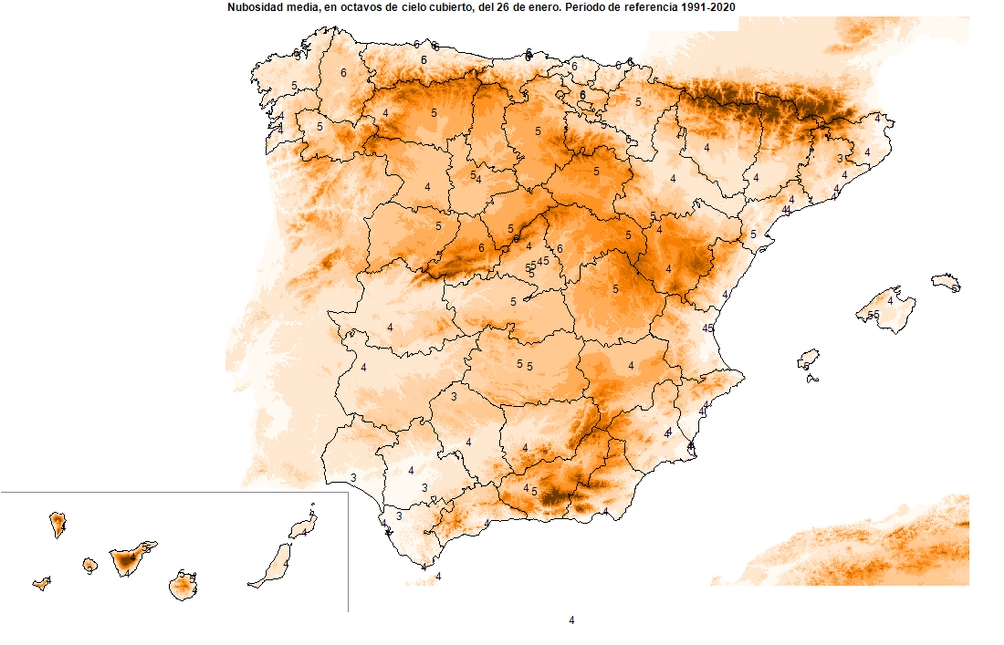
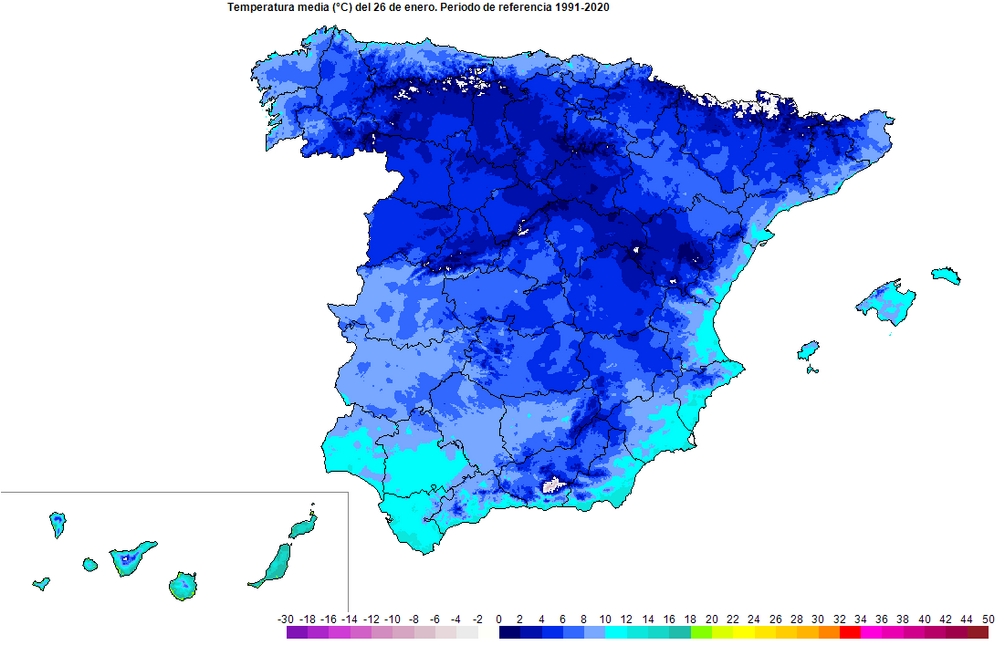
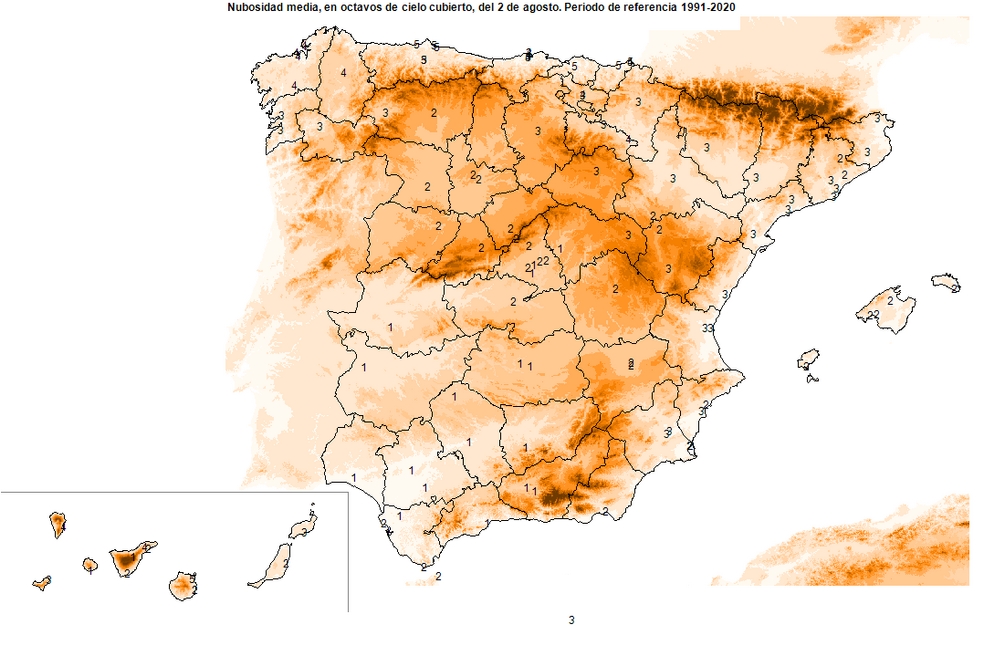
Figure 3 shows the average cloud cover for the date. The most favourable areas can be seen in the Guadalquivir Valley, in the provinces of Huelva, Seville, Cádiz and Córdoba. The presence of the Baetic System worsens conditions in south-eastern Andalusia. Cloud cover also increases as we move into Castilla-La Mancha, decreasing again upon reaching the Ebro Valley.