What is a solar eclipse?
Why do eclipses occur?
When it comes to observing a solar eclipse and fully understanding what we are seeing, the first question to ask is: what is an eclipse? If we consult an etymological dictionary, we find that “eclipse” comes from the Greek ékleipsis, meaning “disappearance” or “abandonment”, which helps us to vividly understand the sensations that people experienced before the development of astronomy when witnessing such a prodigy. In modern terms, an eclipse is an astronomical phenomenon that occurs when the Sun, the Earth and the Moon are aligned, and the body in between casts its shadow on another. The orbits of the three bodies prevent the Sun from ever being the one in the middle—fortunately so, because if that were to happen, not only would there be no eclipse, but it would be catastrophic for our planet. There are therefore two possible scenarios. If the Moon passes between the Sun and the Earth, the Moon’s shadow is cast onto some region of the Earth’s surface, producing a solar eclipse. From that region we are under the Moon’s shadow and see the Sun totally or partially covered by it. If, on the other hand, the Earth lies between the Sun and the Moon, we speak of a lunar eclipse, because from our planet we see the Moon darkened as it passes through the shadow cast by the Earth.
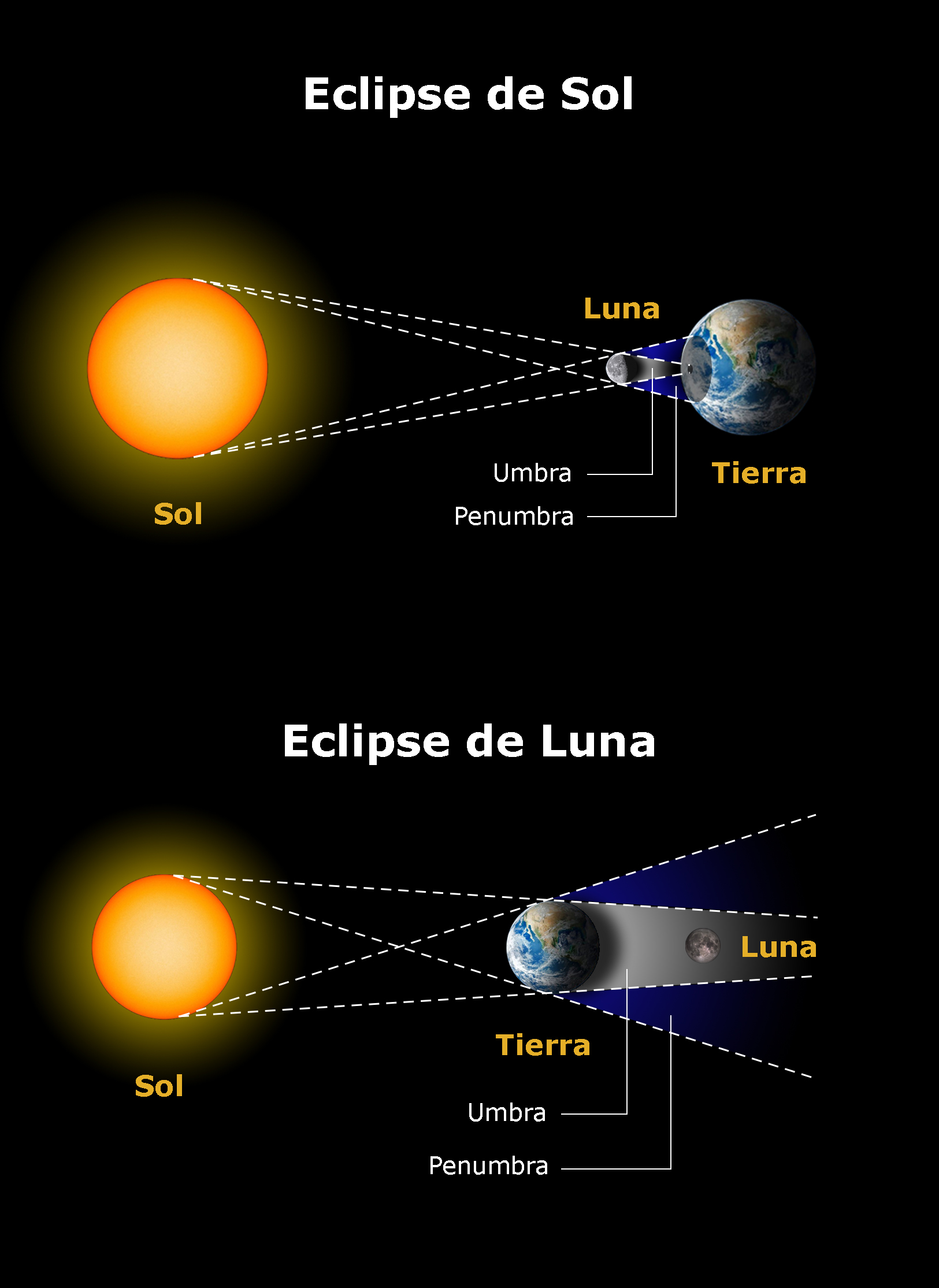
These situations are easy to understand if we remember that the Earth orbits around the Sun, and that the Moon, much closer to the Earth, revolves around it in almost the same plane as the Earth’s orbit. If we position ourselves on Earth looking towards the Sun, when during its 28‑day cycle the Moon passes “in front of” the Earth, a solar eclipse may occur, and when it passes “behind”, a lunar eclipse may take place.
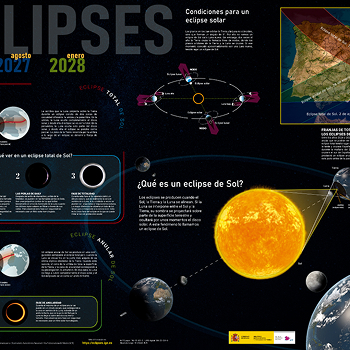
Given this combination of motions, one might think that every lunar orbit should give rise to one solar eclipse and one lunar eclipse, as the Moon passes on either side of the Earth. However, this is not the case; eclipses are far less frequent, and this is due to the following fact: the plane in which the Earth orbits the Sun and the plane in which the Moon orbits the Earth do not coincide exactly, but are slightly inclined with respect to one another, forming an angle of 5°, as shown in the illustration accompanying this text.
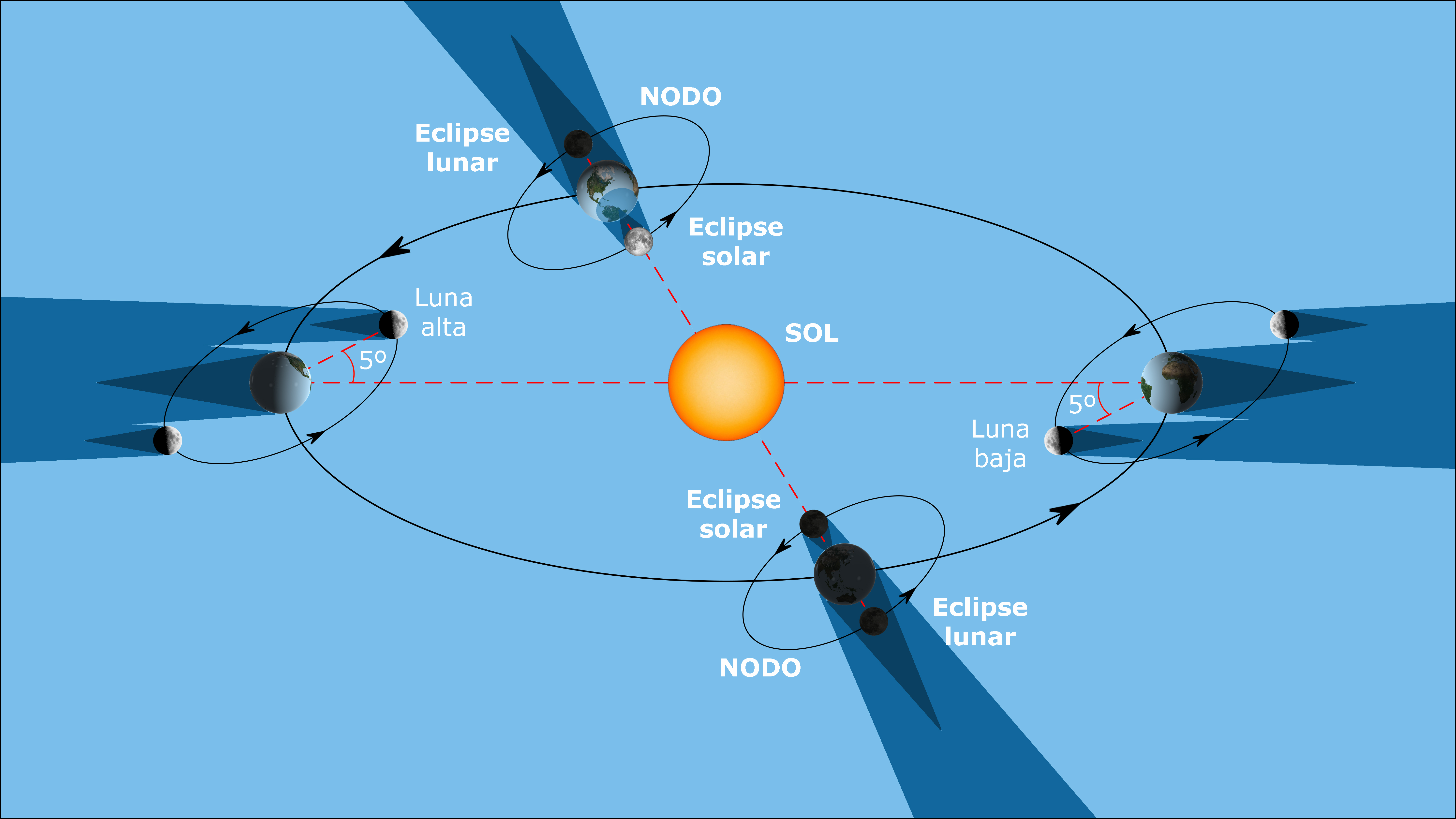
This means that in most cases, as in the configurations shown on the left and right of the accompanying image, the Moon in its orbit passes above or below the line joining the Earth and the Sun, and therefore the alignment of the three bodies required to produce an eclipse does not occur. Alignments only take place in situations such as those shown at the top or bottom of the image, when the Moon passes through the nodes, the points of intersection between the orbital planes of the Moon and the Earth. This happens twice during the Earth’s orbit around the Sun, separated by about six months. Eclipses also tend to occur in pairs: when there is a solar eclipse, it is very common for a lunar eclipse to occur about two weeks before or after it. In this case, the two eclipses are said to be paired.
In view of the above, one might expect eclipses to occur on the same dates every year, on the two occasions when the Earth crosses the line of nodes. However, this is not the case, because the orbits of the Earth and the Moon are neither constant nor commensurable. Although they are represented as ellipses for simplicity, these trajectories are subject to gravitational perturbations caused by the Sun, other planets and Earth tides. As a result, the orbits change subtly over time, and the line of nodes—where the orbital planes of the Moon and the Earth intersect—undergoes a retrograde shift. This motion, which completes a full revolution every 6,798 days, causes the Sun to pass through the same node every 346 days, a period known as the eclipsing year. Consequently, eclipse seasons advance by approximately 19 days each year.
This explains why there are at least two solar eclipses every year. In certain years, if the first occurs early in the year, it is possible for two additional eclipse seasons to occur, allowing for up to five solar eclipses if conditions are favourable, as last happened in 1935 and will not occur again until 2206. This is also facilitated by the fact that the Moon and the Earth are relatively large compared to the distance between them, meaning that the three bodies do not need to be perfectly aligned for an eclipse to take place somewhere on Earth.
Solar eclipses
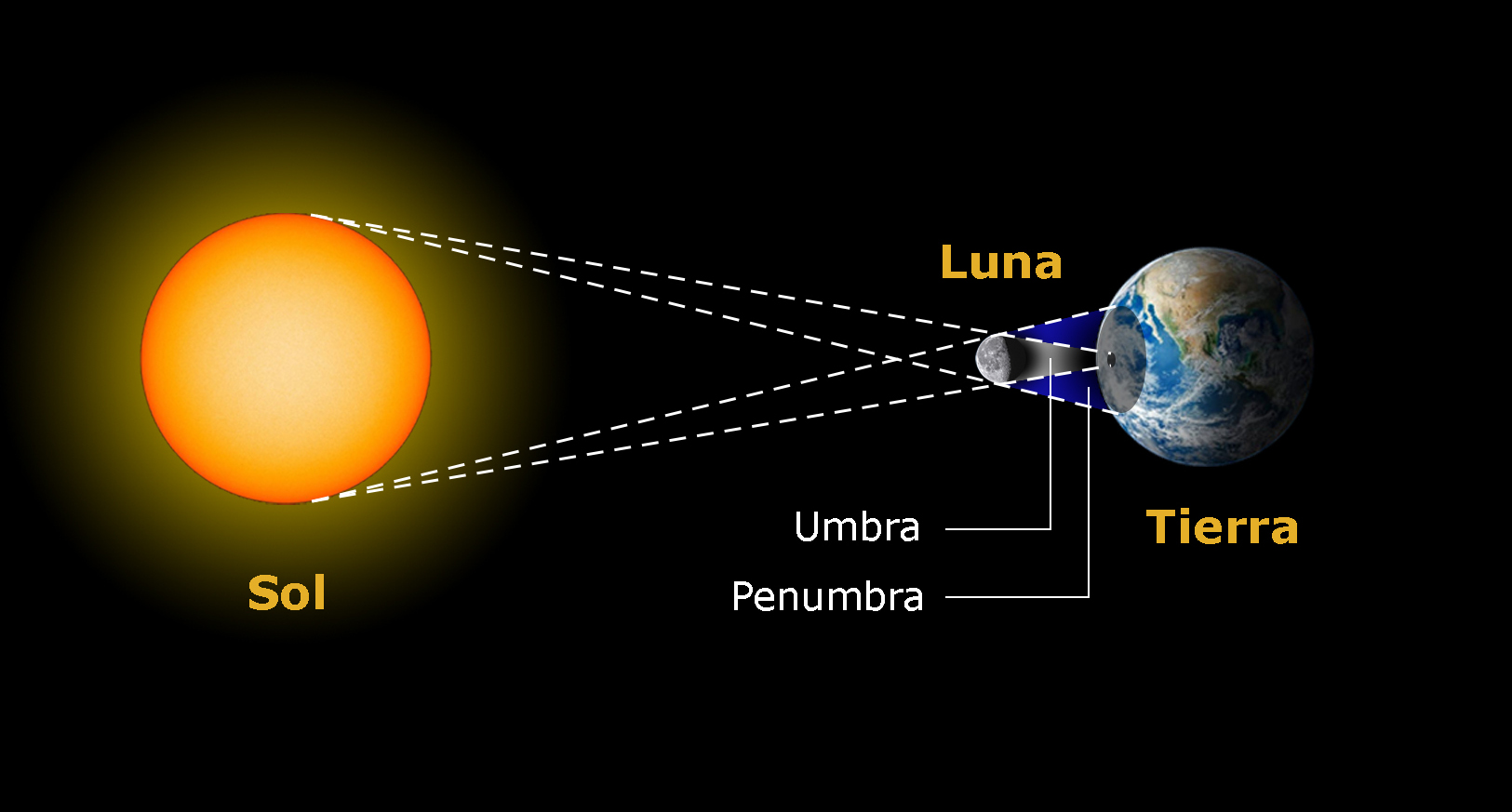
Solar eclipses, as explained in the previous section, occur when the Moon passes between the Sun and the Earth and its shadow falls upon our planet.
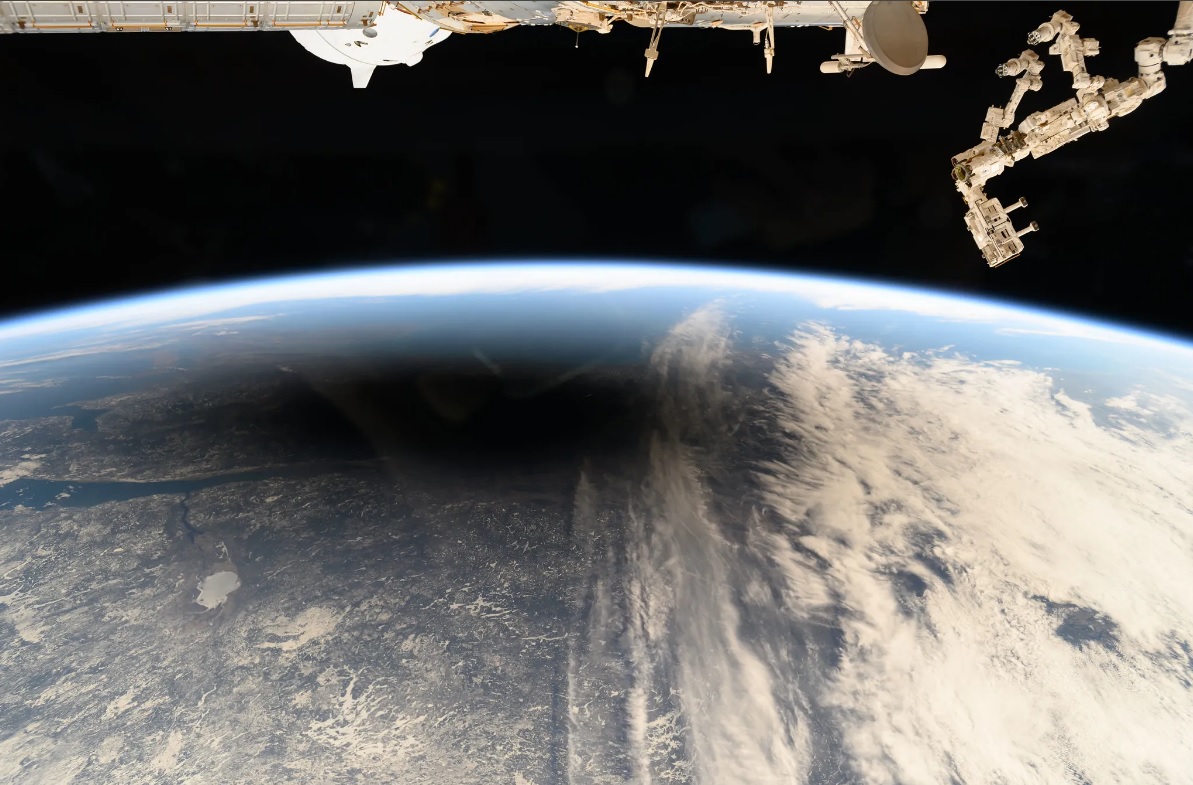
It is important to emphasise that a solar eclipse can only be seen from the region of the Earth upon which the Moon’s shadow falls; elsewhere, where the surface remains illuminated, the eclipse is not visible at all. This differs from lunar eclipses, which, when they occur, can be seen from much wider areas, and makes observing a solar eclipse a particularly exceptional event.
Magnitude and obscuration of a solar eclipse
To indicate the extent to which the Moon is covering the Sun during a solar eclipse, different parameters can be used. One of these is the magnitude, which indicates what fraction of the Sun’s angular diameter is being covered. It is a ratio between diameters (covered and total), not between areas. In a partial or annular eclipse, the magnitude is always between zero and one, with greater coverage the closer the value is to one. The magnitude can be expressed either as a decimal or as a percentage (for example, 0.2 or 20%, over a solar diameter taken as 1 or 100%). In a total eclipse, the magnitude is the ratio of the Moon’s angular diameter to that of the Sun, and is always equal to or greater than one. Another related concept is obscuration, which indicates the fraction of the Sun’s area that is covered by the lunar disc. There is no unique correspondence between magnitude and obscuration, due to variations in the Moon’s angular size along its orbit. This means that in certain solar-eclipse configurations the magnitude may be the same while the percentage of the Sun’s surface that is covered—and therefore the obscuration—differs.
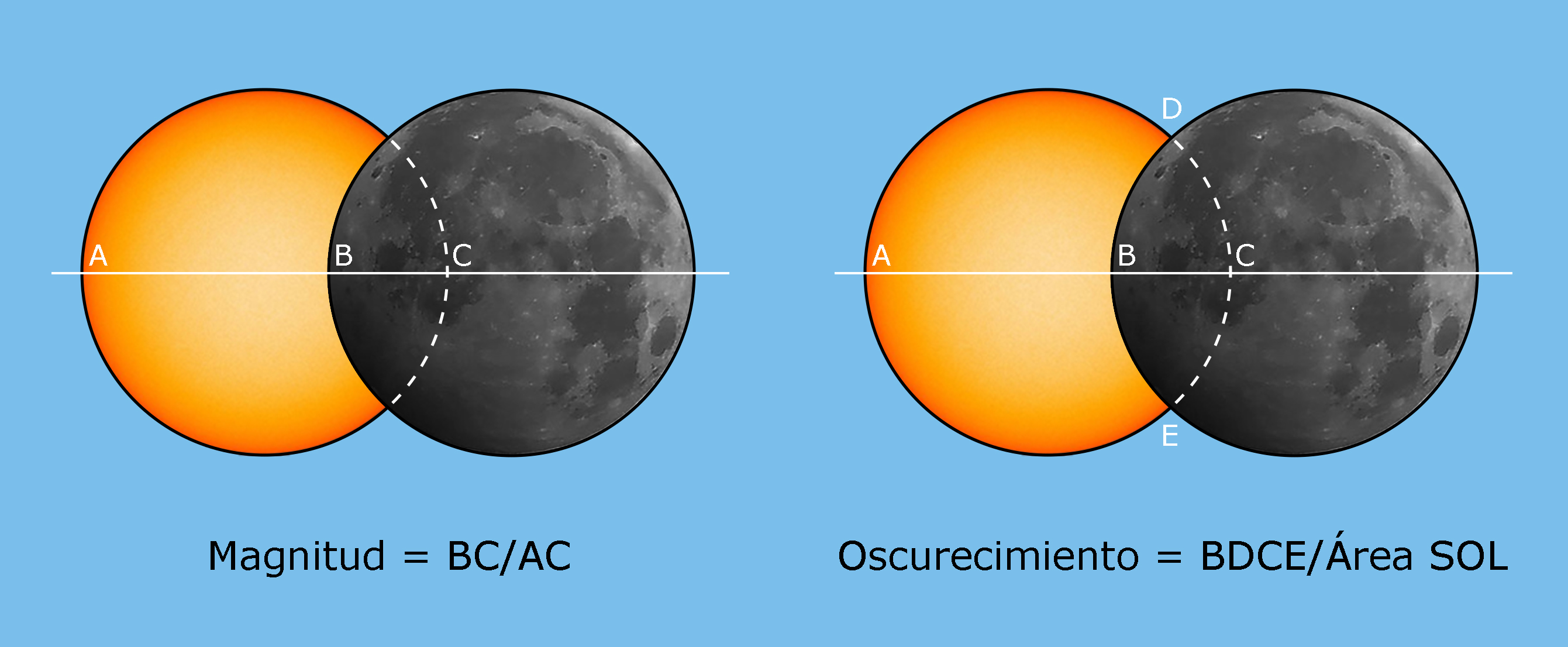
Types of solar eclipses
The type of solar eclipse that can be observed from a given region of the Earth depends on whether the Moon covers the solar disc totally or partially, and in what way. We can observe three types of solar eclipses: total, annular and partial.
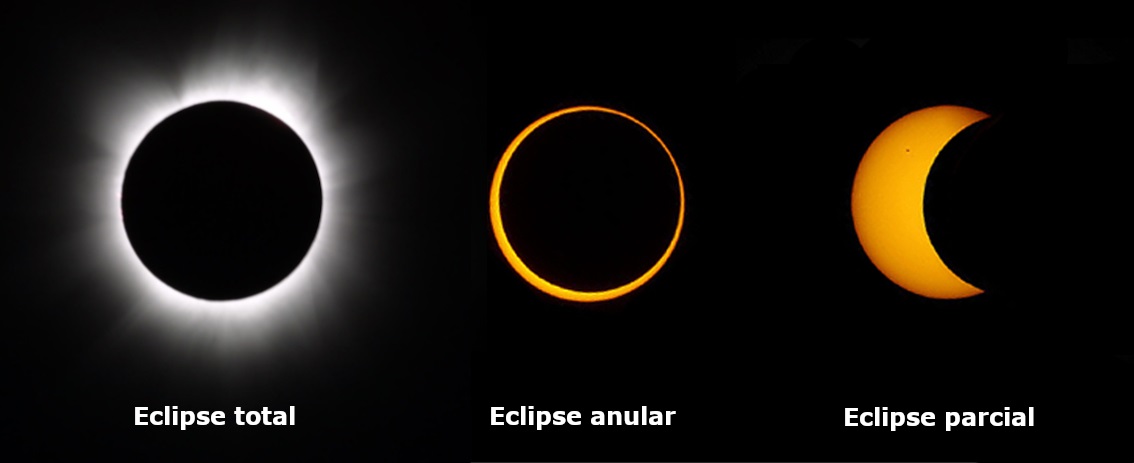
Total solar eclipse
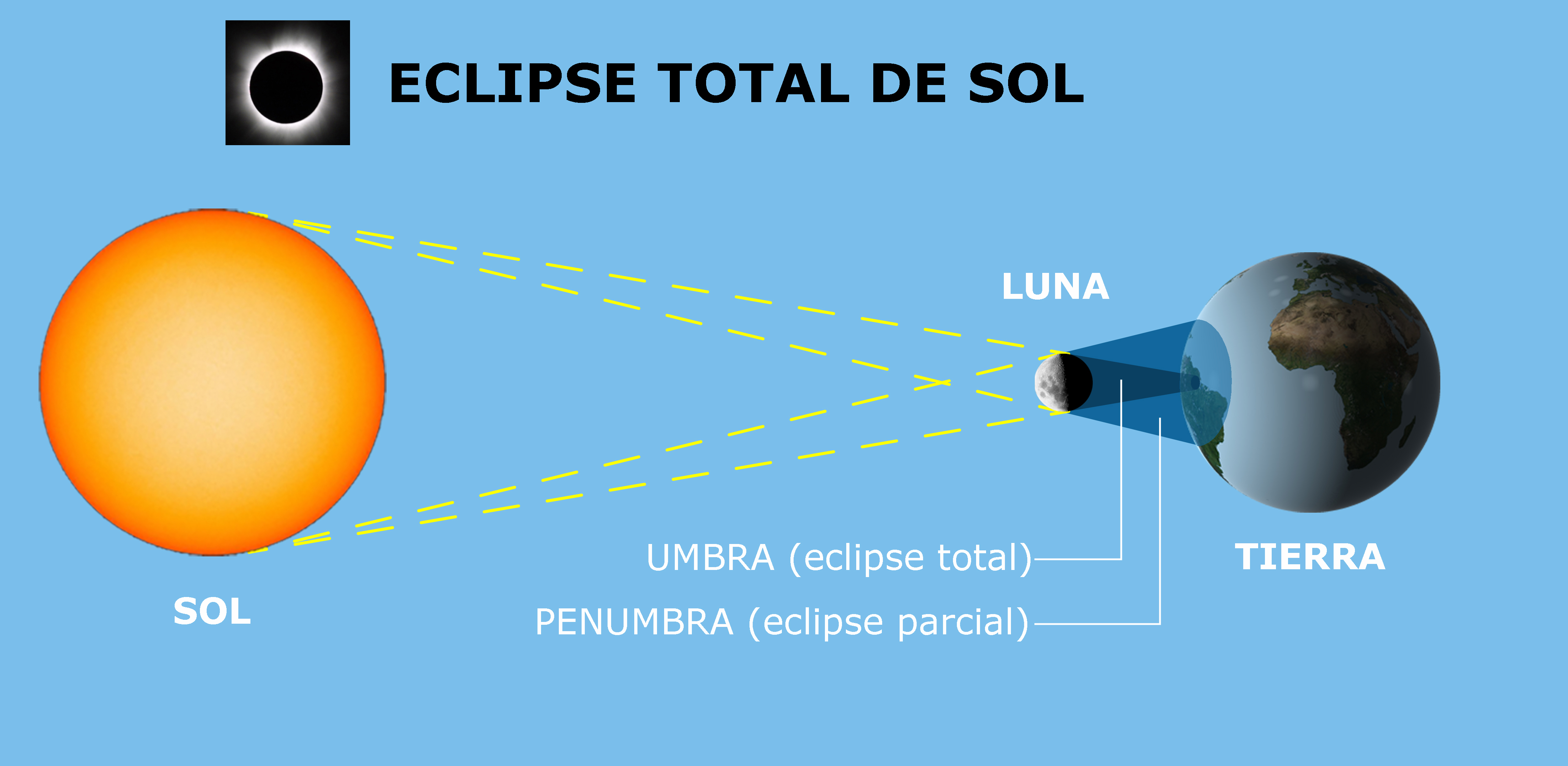
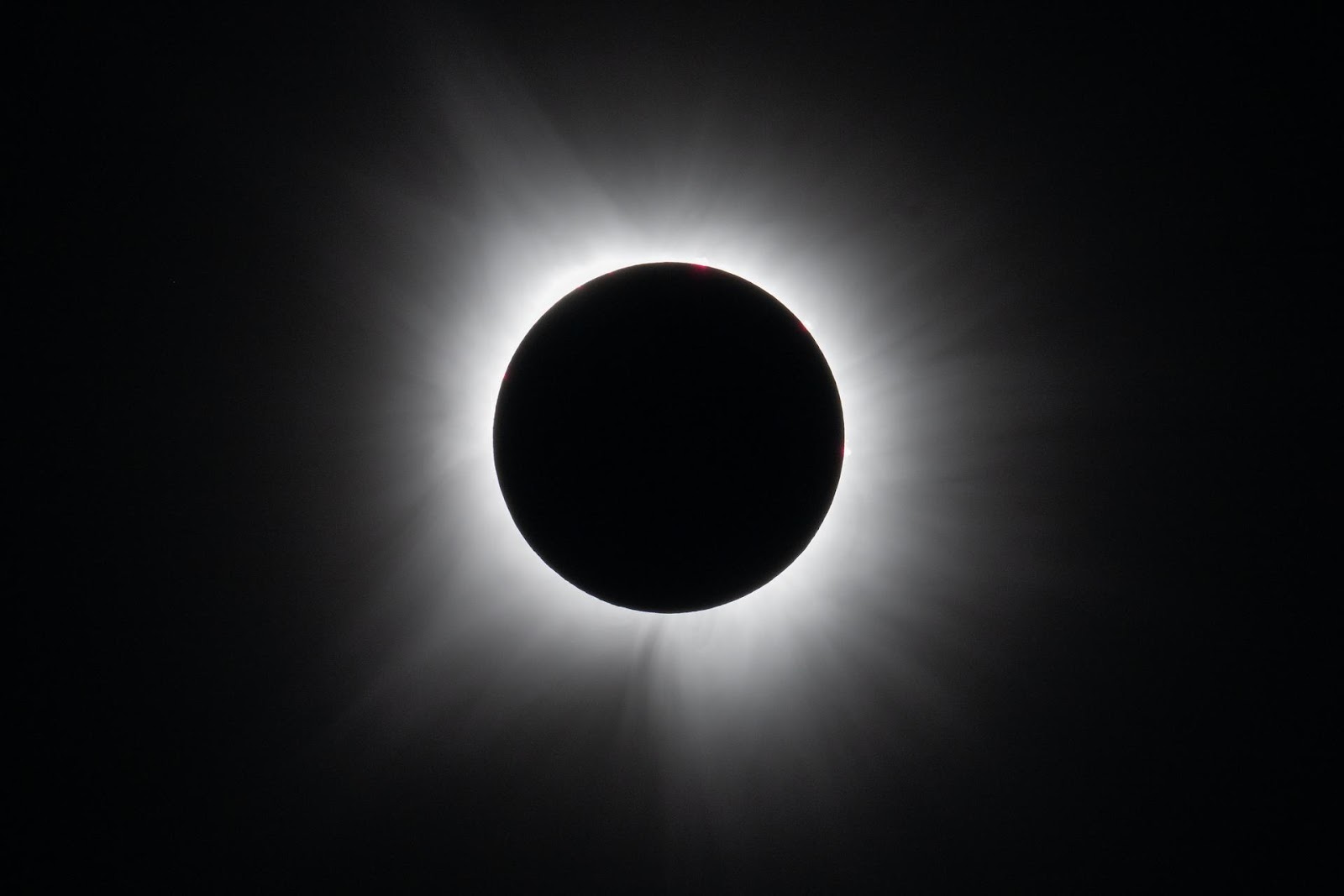
If we look again at the diagram of solar eclipses, we can distinguish two regions in the shadow cast by the Moon onto our planet: the umbra and the penumbra. Any region of the Earth onto which the umbra is projected—the darkest and deepest part of the shadow, where the light source is completely blocked—will experience a total solar eclipse. In this case, the Moon completely covers our star, resulting in a significant drop in brightness and temperature, even though it is daytime. Observing a total solar eclipse is an exceptional event: as shown in the diagram, the area over which the umbra is projected on the Earth, where totality occurs, is very small. However, it is important to note that the rotation of the Earth helps totality to be visible from more locations, as the umbra traces an arc-shaped path across the planet’s surface during the eclipse. This path is known as the path of totality.
By contrast, regions located within the penumbra will witness a partial eclipse, in which the Moon covers only a portion of the Sun’s surface, but never all of it. As a result, these regions continue to receive solar radiation and, since it is so intense, the decrease in brightness is not as evident. Elsewhere on the planet, outside both the umbra and the penumbra of the lunar shadow, the eclipse will not be visible at all.
Total solar eclipses occur thanks to a fortunate coincidence of nature, based on the fact that, as seen from the Earth, the Moon and the Sun appear to be very similar in size in the sky. The Moon is, of course, much smaller than the Sun—about 400 times smaller—but it is also about 400 times closer to the Earth. This numerical coincidence means that both appear as similarly sized discs in the sky, something that is purely coincidental rather than the result of any physical law. This coincidence makes it possible, under suitable positional configurations, for the lunar disc to completely cover the Sun. This good fortune will not last indefinitely: due to tidal forces between the Earth and the Moon, our satellite is receding from us by about 3.8 centimetres per year. Although this seems negligible compared with the average Earth–Moon distance of 384,400 kilometres, over the course of millions of years the effect will become significant. In roughly 600 million years, total solar eclipses will cease to exist, as the Moon will no longer be able to completely cover the Sun.
Annular solar eclipse
An annular solar eclipse occurs under a configuration of positions similar to that of a total eclipse, in which the Moon passes through a node of the orbital planes and an almost perfect alignment of the three bodies takes place, with the Moon positioned between the Earth and the Sun.
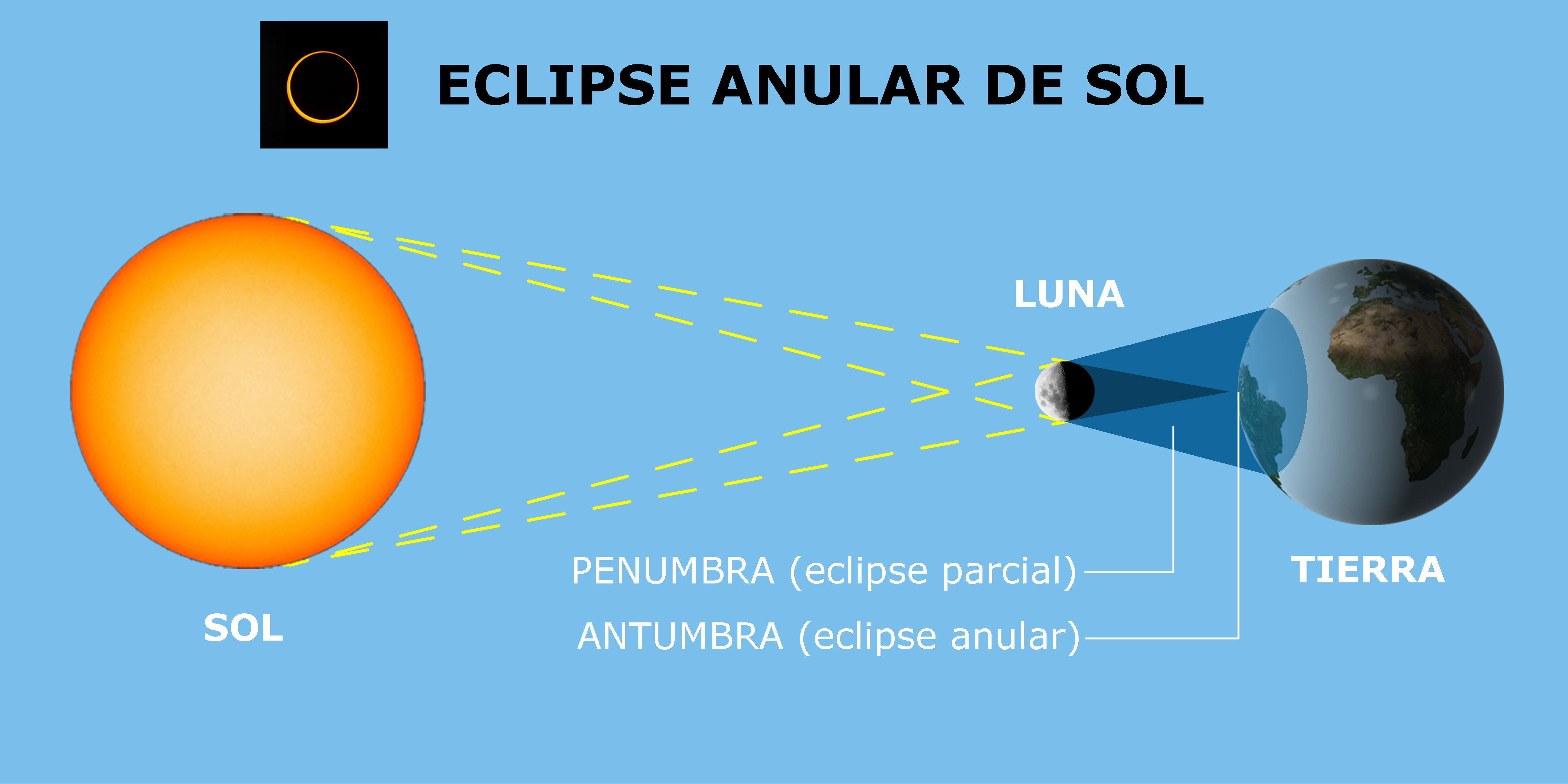
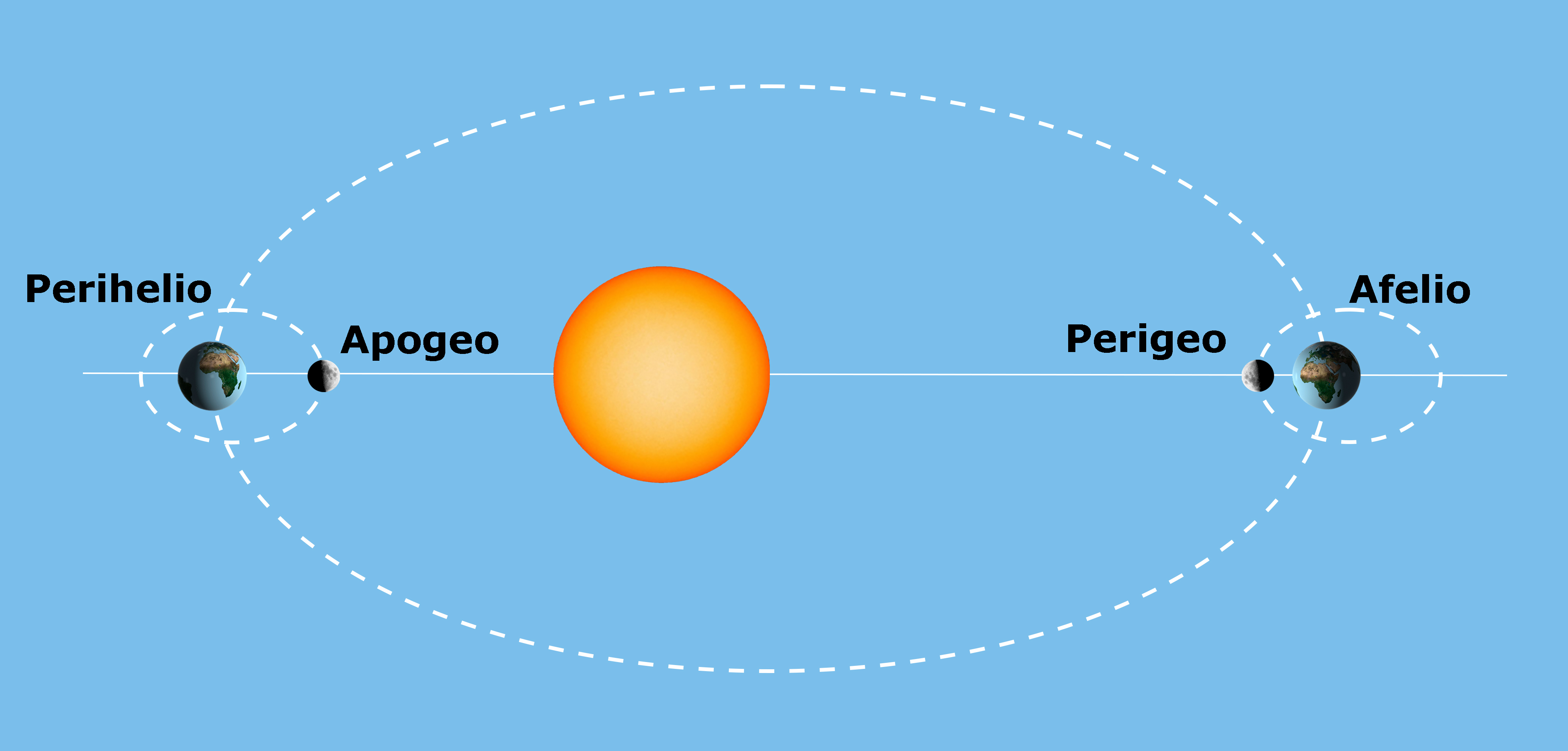
In this case, however, the Sun is not completely obscured by the Moon, because the tip of the lunar umbral cone does not reach the Earth’s surface. To understand this, we must take into account that the orbits of both the Earth and the Moon are not circular, but elliptical. This means that the distance between the bodies involved varies along the orbit. The point at which the Earth is closest to the Sun is called perihelion, while the most distant point is called aphelion. Similarly, in its orbit around the Earth, the Moon reaches perigee at its minimum distance and apogee at its maximum. These positions are shown in the following diagram, where the ellipticity of the orbits has been exaggerated for illustrative purposes. In reality, the orbits are much closer to circular (the current eccentricity of the Earth’s orbit is 0.0167, and that of the Moon’s orbit is 0.0549).
Depending on where the Earth and the Moon are located in their respective orbits (closer to or farther from their central body), we observe variations in the apparent sizes of the Sun and the Moon in the sky. The Sun’s apparent size varies relatively little, by around 3%. The Moon’s variation is greater, with a difference of about 14% between its maximum apparent size at perigee and its minimum at apogee.
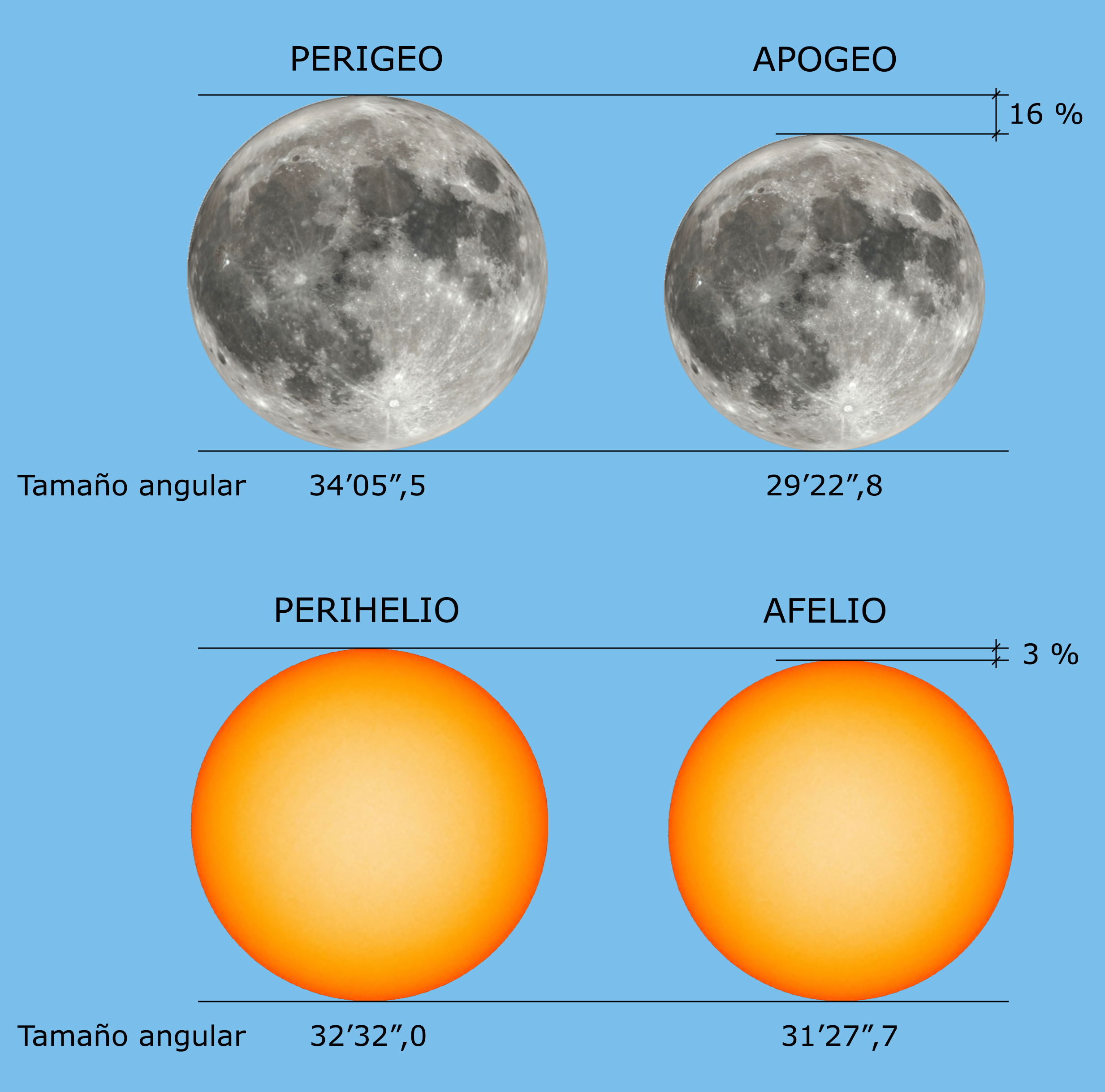
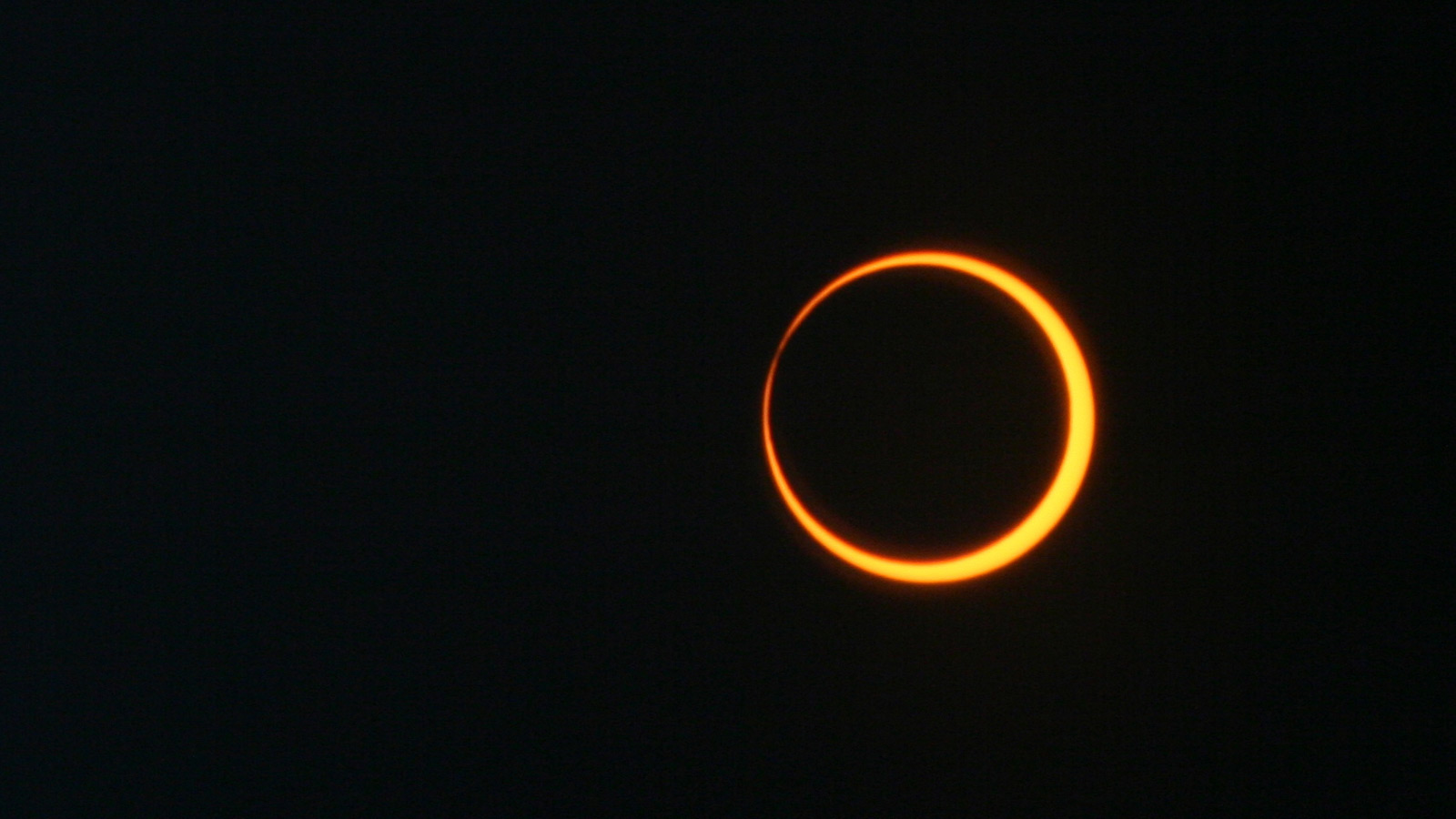
Because the apparent sizes of both bodies as seen from the Earth are so similar, the Moon appears slightly larger than the Sun when it is close to perigee and the Earth is closer to aphelion. Conversely, the Sun appears slightly larger than the Moon when the Earth is near perihelion and the Moon is near apogee. Thus, when the three bodies align, a total solar eclipse occurs if, in that particular orbital configuration, the Moon’s apparent size is equal to or larger than that of the Sun. Otherwise, if the Moon’s apparent size is smaller, it will not be able to fully cover the Sun’s disc, resulting in an annular eclipse. In these cases, the umbral cone ends before reaching the Earth’s surface, and the region of annularity—from which the annular eclipse is visible—is defined by its extension, the antumbra, and the path it traces across the Earth’s surface due to the planet’s rotation.
Partial solar eclipse
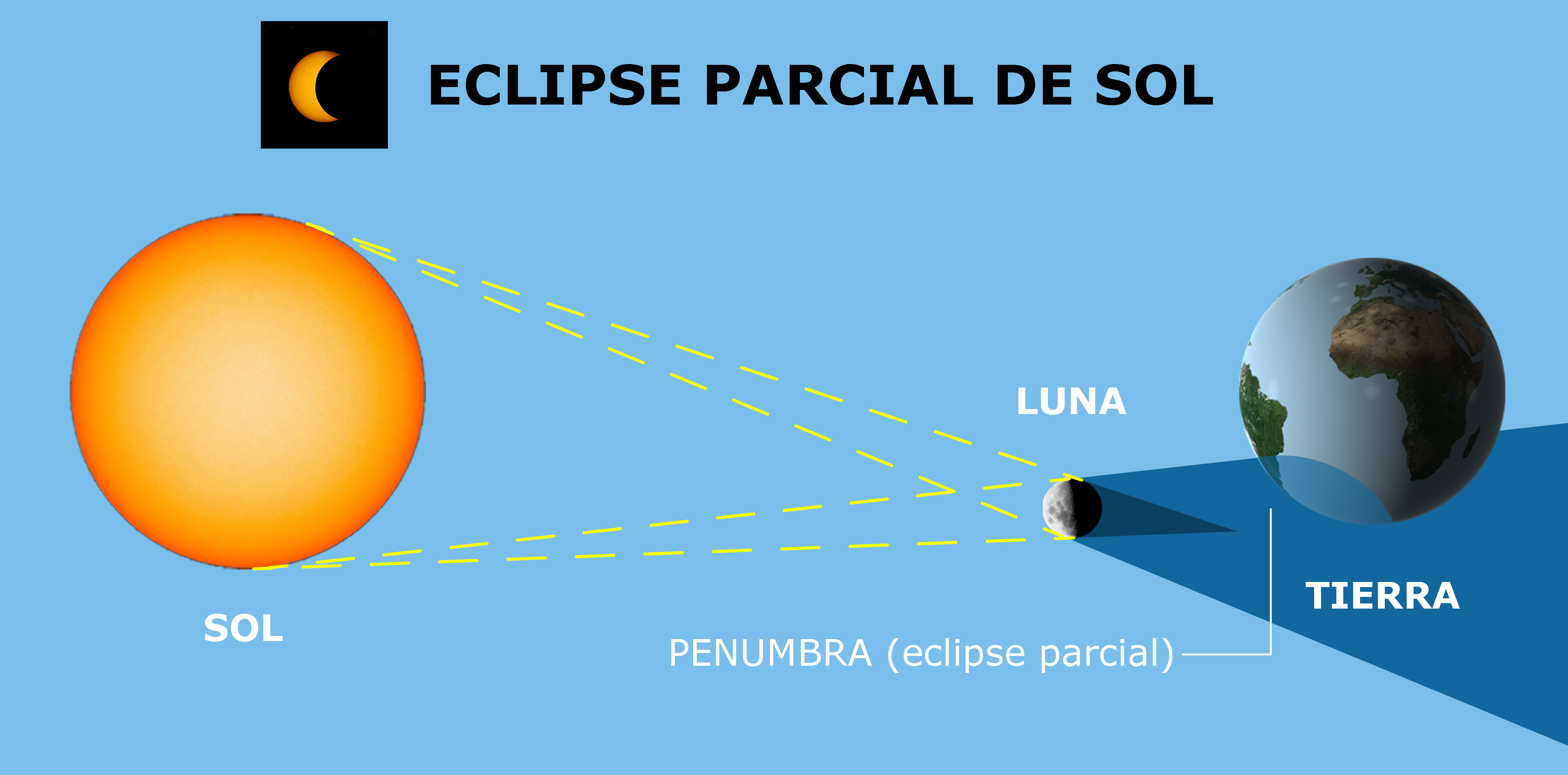
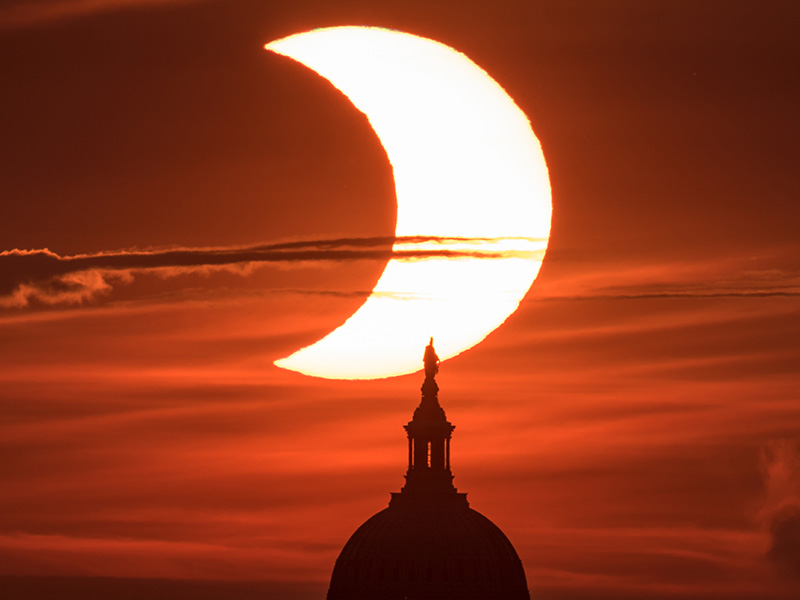
A partial solar eclipse occurs when the Moon covers only a fraction of the Sun’s surface. This can happen under different circumstances. One possibility is the situation that occurs during a total solar eclipse for regions of the Earth located within the penumbra of the Moon’s shadow. An analogous case occurs during annular eclipses. Another configuration arises when the Moon does not pass exactly through a node, but slightly above or below it, as shown in the accompanying diagram. In this case, neither the umbra nor the antumbra is projected onto the Earth, so no total or annular eclipse occurs, but the penumbra does affect part of the Earth’s surface. From those regions, a partial eclipse is observed.
Hybrid solar eclipse
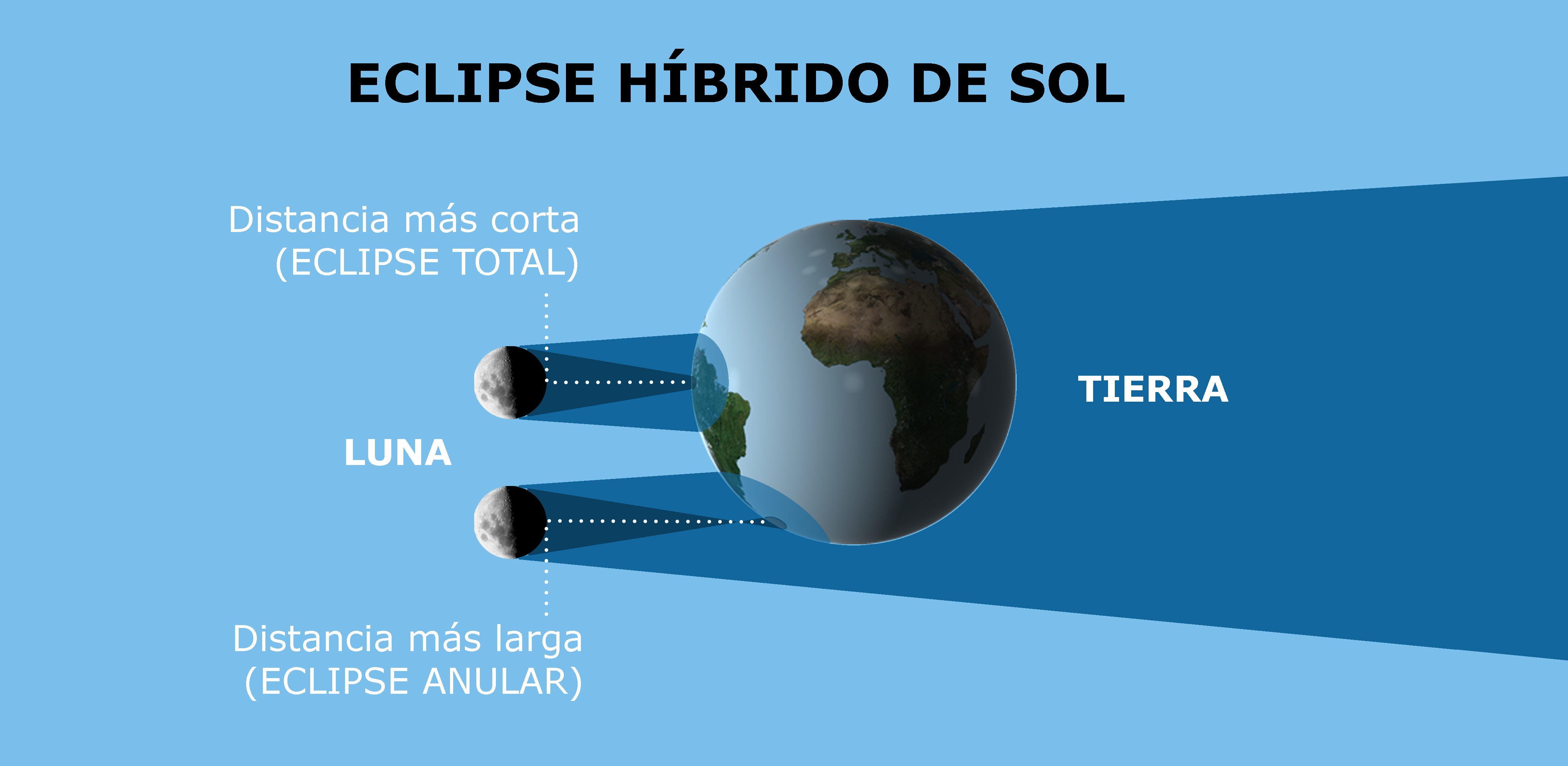
The so‑called hybrid solar eclipse is not a type in itself, but a combination of two. It occurs when the Moon’s distance at that moment, the shape of its path, and the curvature of the Earth cause the eclipse to be seen as total from some regions of the Earth and as annular from others. In such cases, the eclipse may begin as annular, become total along part of its path, and then revert to annular again. It may also show only two phases: annular–total or total–annular. These eclipses are also known as annular–total eclipses. Fewer than 5% of all solar eclipses are hybrid eclipses.
Lunar eclipses
Although this volume focuses on solar eclipses, for the sake of completeness we will provide a general description of lunar eclipses and their types. Lunar eclipses occur when our satellite passes through the shadow cast by the Earth as a result of illumination from the Sun. This means that they always take place at full Moon. As with solar eclipses, they occur only when the Moon passes through or close to the nodes, that is, the points where its orbit crosses the Earth’s orbital plane. Unlike solar eclipses, which can only be observed from those regions of the Earth’s surface onto which the Moon’s shadow is projected, lunar eclipses are visible from anywhere in the world where it is night-time at the moment of the eclipse. As a result, although they are just as likely to occur as solar eclipses, from any given location it is far more common to observe a lunar eclipse than a solar one.
Types of lunar eclipses
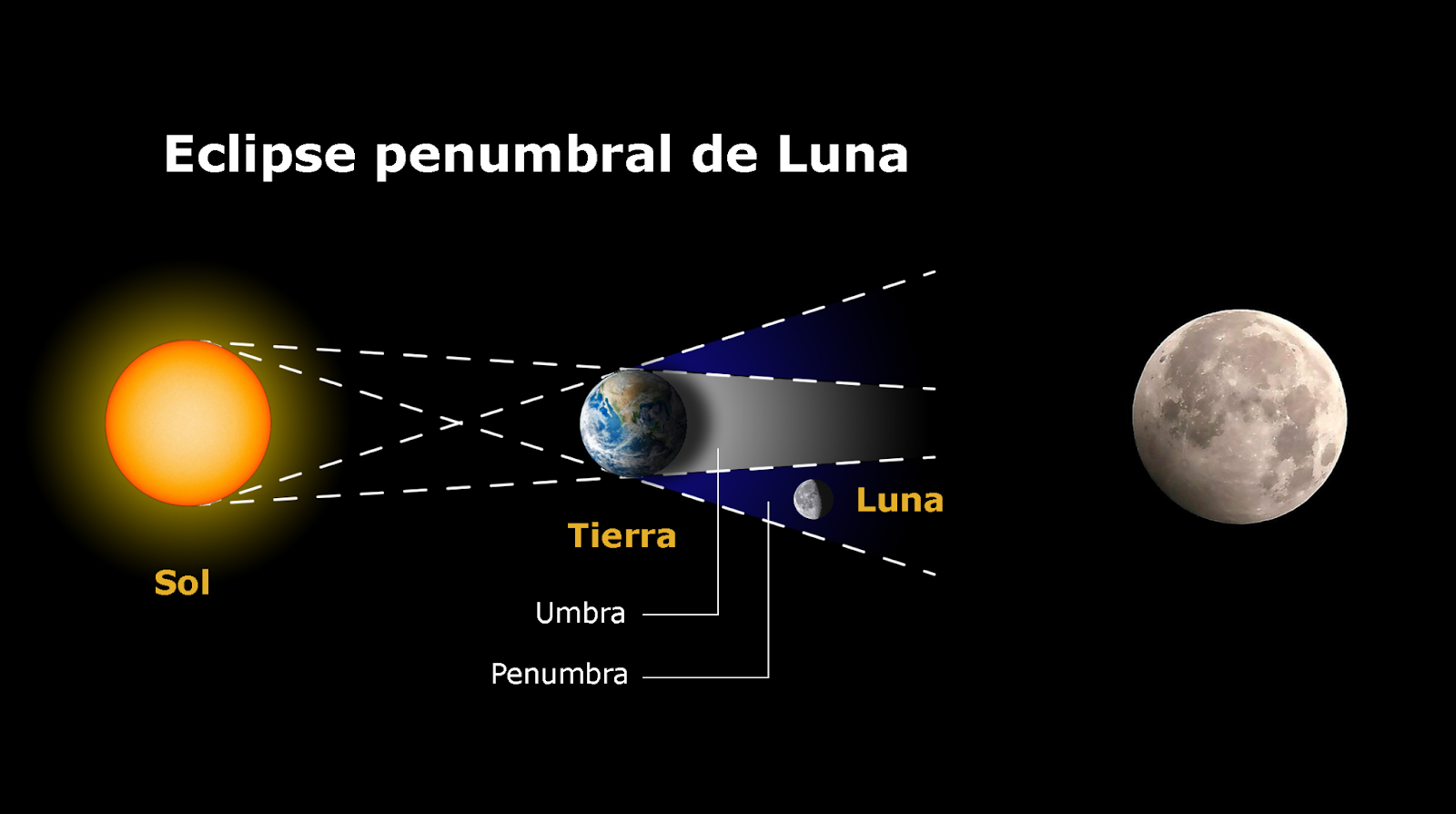
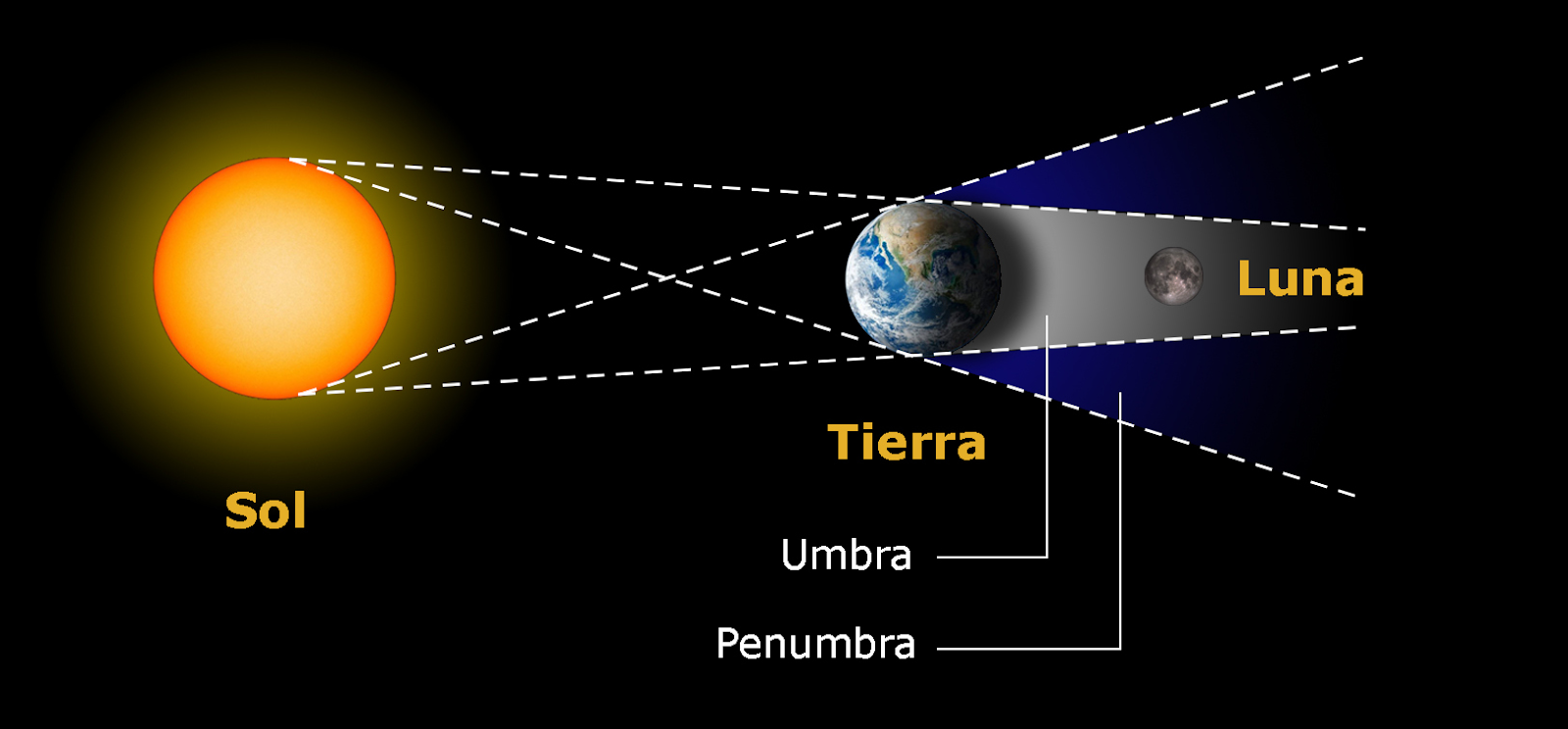
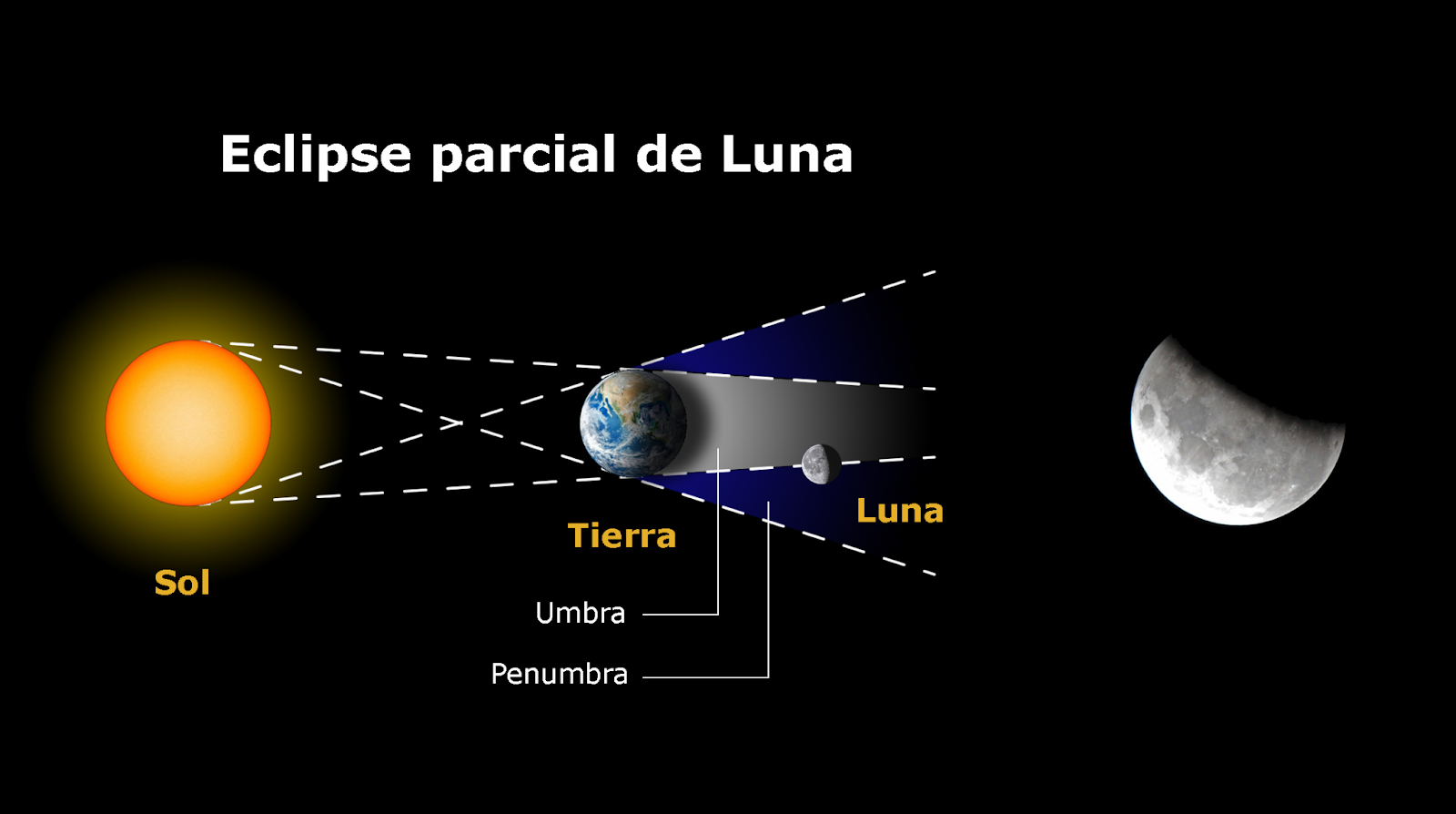
We can consider two regions within the shadow cast by the Earth: the umbra, which is denser and where no direct solar radiation reaches, and the penumbra, where solar radiation is only partially blocked. The types of lunar eclipse depend on the region of the Earth’s shadow through which the Moon passes.
Total lunar eclipse
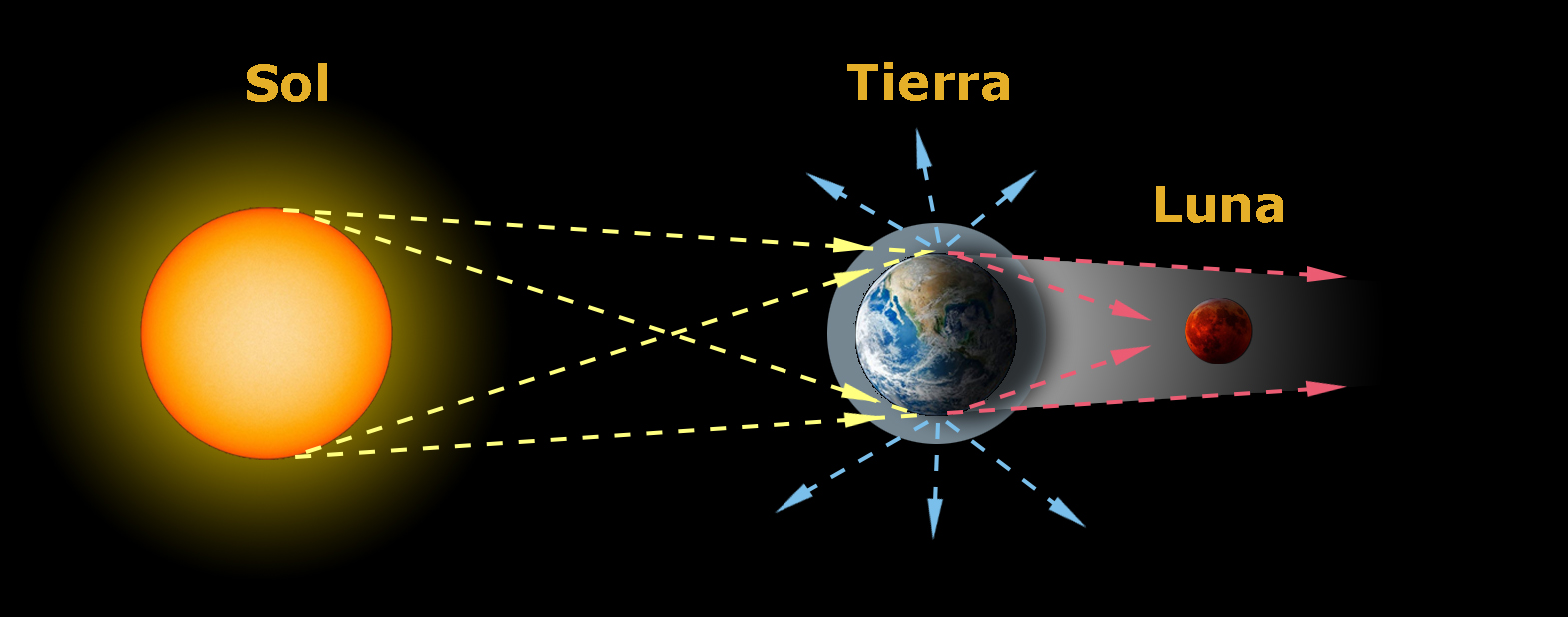
A total lunar eclipse occurs when the Moon enters completely into the Earth’s umbra. This is the configuration shown in the diagram in section 3.4. In this case, the planet prevents the Moon from receiving direct radiation from the Sun. However, since the Moon does not emit its own light but instead reflects the light it receives, one might think that during a total lunar eclipse our satellite should not be visible at all. This is not the case: although its brightness decreases dramatically, the Moon can be seen tinged with a characteristic reddish colour during total eclipses.
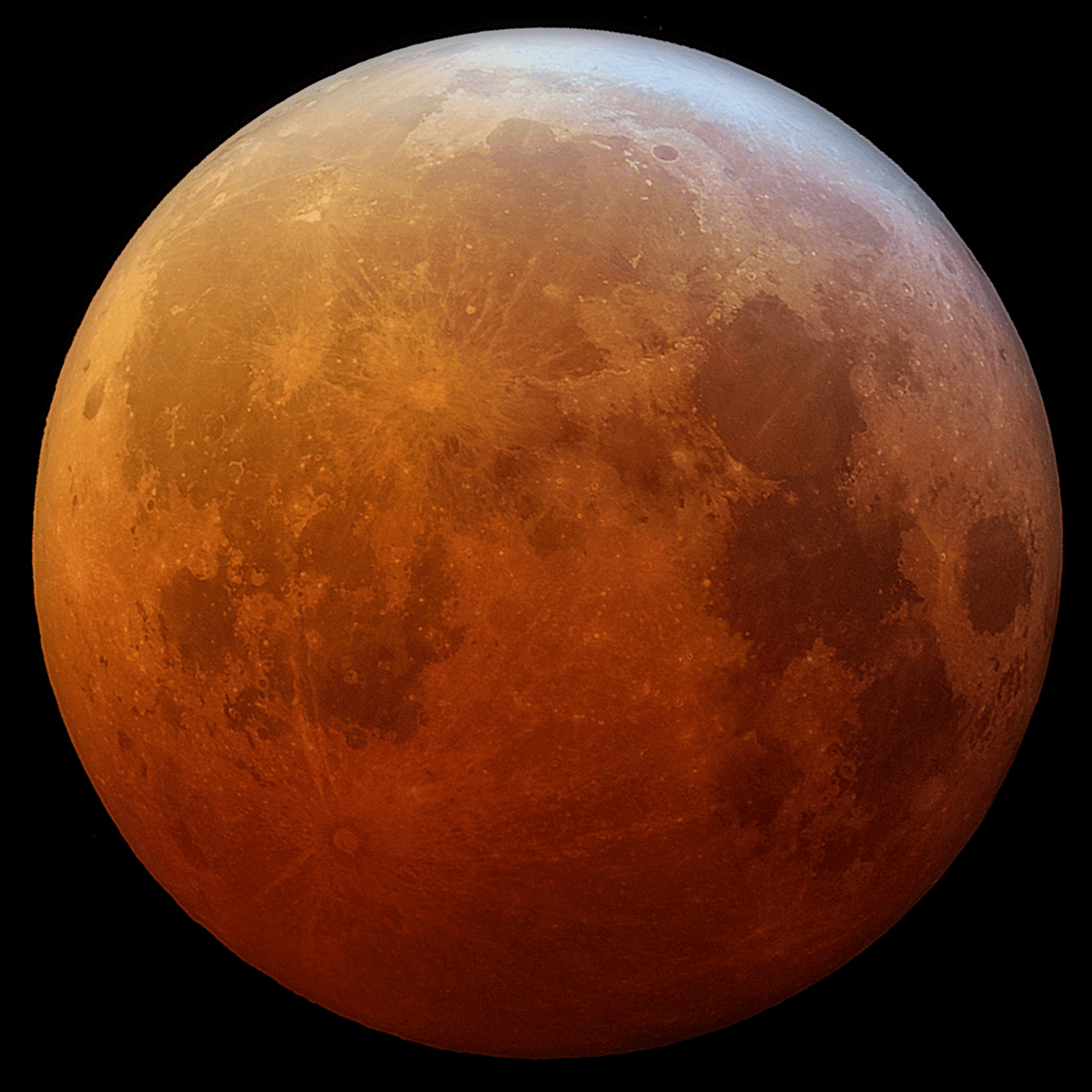
The cause of this distinctive effect is none other than our atmosphere. During a total lunar eclipse, our satellite does receive a certain amount of sunlight—namely, light that passes through the edges of the Earth and is scattered by the air surrounding our planet. Atmospheric scattering of light with shorter wavelengths (blue and violet) is very efficient, so much of it is lost into space (and, incidentally, gives rise to the blue colour of the sky). By contrast, the scattering of light with longer wavelengths (red and orange colours) is much less efficient, and therefore this light largely maintains a direction similar to its original path. As a result, the Moon receives a higher proportion of red light filtered by our atmosphere, which gives it its characteristic eclipsed colour. The greater the cloud cover in the Earth’s atmosphere during the eclipse, the redder our satellite will appear.
Partial lunar eclipse
A partial lunar eclipse occurs when only part of the Moon enters the umbra, while the remainder stays within the penumbra. In this type of eclipse, there is a general reduction in the Moon’s brightness, and the darkened portion that lies within the umbra can be seen. It is interesting to note that the curve of the shadow we observe is the edge of the Earth’s shadow, and it has a different curvature from the line between light and shadow that we see when the Moon is in its waxing or waning phases. Here, the reddening effect of the light caused by the Earth’s atmosphere is much less noticeable, owing to the intense brightness of the lunar surface that remains outside the umbra.
Penumbral lunar eclipse
This type of eclipse occurs when the Moon enters the Earth’s penumbra but does not touch the umbra. A subtle darkening of the lunar surface takes place, becoming more pronounced the greater the proportion of the Moon that lies within the penumbra. If this proportion is small, the eclipse may be very difficult to perceive with the naked eye. A total penumbral eclipse can occur, in which the entire Moon is within the penumbra without entering the umbra, but such events are very rare, because the width of the penumbral zone is only slightly larger than the diameter of the Moon.