Number of eclipses per year
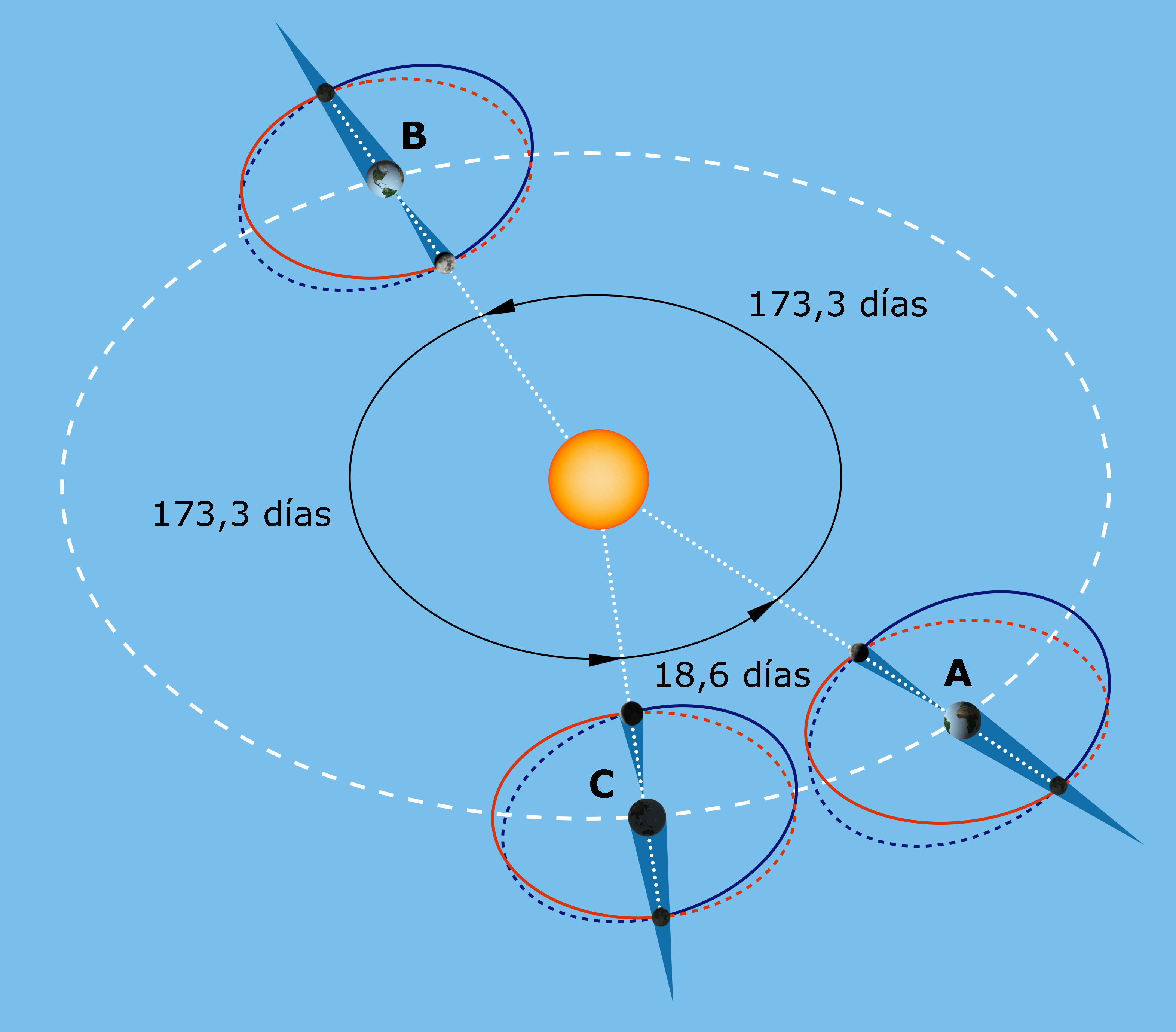
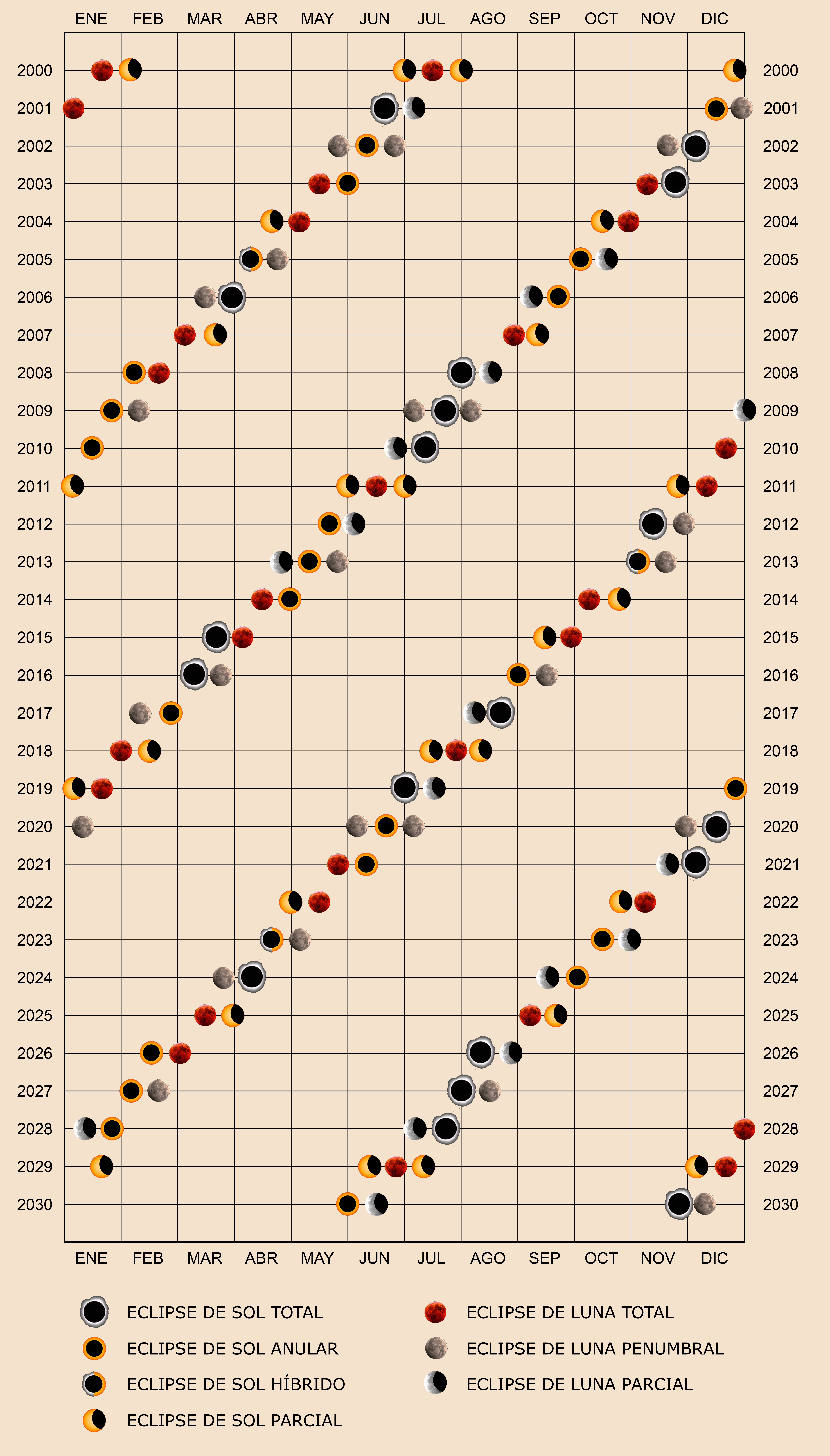
As eclipses occur when the nodes of the Moon’s orbit are aligned with the Sun (see the section “Why do eclipses happen?”), they take place in groups known as eclipse seasons. These seasons are separated by approximately 173.3 days, so each year there are two, or very rarely three, eclipse seasons. When the first season occurs at the beginning of the year, there will be a third, incomplete one at the end. An eclipse year comprises two eclipse seasons, that is, 346.6 days.
Normally, a solar eclipse and a lunar eclipse occur together, meaning that one takes place half a lunation after the other. As a result, between 4 and 7 eclipses occur each year, including both solar and lunar eclipses, with at least two eclipses of each type.
Throughout this century, there will be 223 solar eclipses, of which 68 will be total, 72 annular, 7 hybrid (annular/total) and 76 partial. Likewise, there will be 230 lunar eclipses, 85 of them total, 58 partial and 87 penumbral.
Saros cycle
When looking at the dates on which eclipses occur year after year, it might appear that they show no periodicity, but this is not the case. For eclipses to occur, the Sun and the Moon must be close to specific positions with respect to the Earth. The Sun, for example, must be close to the line of nodes of the Moon’s orbit with respect to the Earth. The Moon, in turn, must also be close to one of the nodes and be in the new phase for a solar eclipse to occur, or in the full phase for a lunar eclipse to be possible.
These positions repeat periodically, although their periods are different. The time that elapses between two successive full Moons, known as the synodic month or lunation, is approximately 29.5 days. An eclipse year, as we have seen, lasts 346.6 days. Using these two values, it can be shown that 223 lunations correspond almost exactly to 19 eclipse years. After this interval, known as a saros, the Moon and the Sun will be approximately in the same position with respect to the Earth, with the Moon in the same phase. In other words, after this interval, an eclipse will occur under very similar conditions. This does not mean that it will be observed from the same location on Earth, since a saros is equivalent to 18.03 tropical years (the basis of the civil calendar), or 6,585.32 days. This additional third of a day means that the Earth’s surface does not occupy the same position, and the new eclipse is visible from a different region of our planet. A table with more detailed calculations is shown below.
| Period | Duration | Saros |
|---|---|---|
| Lunation | 29.53059 days | 1 saros = 223 lunations = 6,585.32135 days |
| Eclipse year | 346.62008 days | 1 saros = 18.99867 eclipse years |
| Tropical year | 365.24219 days | 1 saros = 18.03001 tropical years |
Although after one saros an eclipse will occur under almost the same conditions, it will not be exactly identical, as the nodal line undergoes a precessional motion opposite to the Moon’s orbital motion. For this reason, what are known as saros series have been defined: sequences of eclipses separated by one saros, which begin with a partial eclipse. The series that began with the eclipse of 4 June 2873 BC was chosen as Solar Series 1. Odd-numbered solar series begin when the Sun enters the ascending node, and successive eclipses shift southwards, becoming total or annular, and finally partial again as the Sun moves away from the node, until eclipses are no longer possible. Even-numbered series occur at the descending node and move northwards. For lunar series, the situation is reversed. At present, solar series 117 to 156 and lunar series 110 to 150 are active.
The saros was already known in ancient times, with records dating back to Babylon and continuing through ancient Greece. Other civilisations were also able to predict eclipses and must therefore have had detailed knowledge of the apparent motions of the Sun and the Moon, and thus of this cycle. This is known to have been the case in pre-Columbian cultures such as the Maya and the Mexica, in the Chinese empire, and in India.
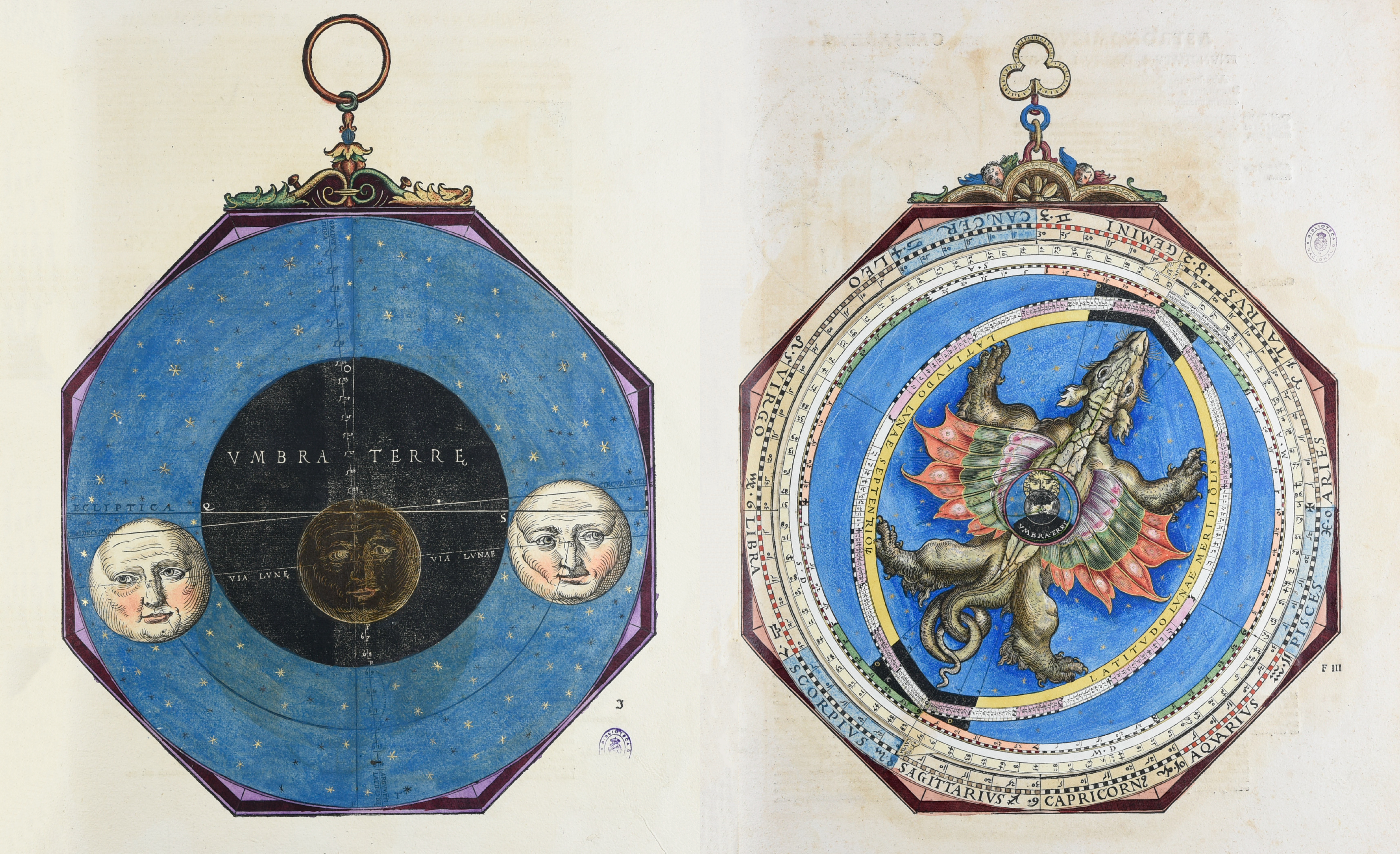
The term saros itself (Greek σάρος) was introduced by Edmond Halley in the 17th century, based on a Byzantine text entitled Suda. This text referred to a period of 222 lunar months known to the Chaldeans and was based on the writings of Eusebius of Caesarea, who in turn cited a Babylonian author named Berossus. Later, in the 18th century, Guillaume Le Gentil pointed out that although the period of 223 lunar months was very useful for predicting eclipses, the use of the term was incorrect, as it did not correspond to what the Chaldeans understood by saros, nor was it consistent with its actual precision. Despite this, the use of the term became widespread and remains prevalent today.
In addition to the saros, there were other cycles known in antiquity that allowed eclipses to be predicted with greater or lesser accuracy:
The octaeteris was a period of eight solar years known in ancient Greece. After these eight years, the same lunar phase recurs within one or two days. It was discovered by Cleostratus, who assigned it a duration of 2,923.5 days.
The Metonic cycle was introduced by Meton of Athens and lasted 6,940 days. This duration is very close to that of 235 lunations (6,939.7 days) and to that of 19 tropical years (6,939.6 days).
The Callippic cycle was an improvement to the Metonic cycle proposed by Callippus of Cyzicus. It was obtained by taking four Metonic cycles and subtracting one day, resulting in a period of 27,759 days, corresponding to approximately 76 years and 940 lunations.
Hipparchus of Nicaea also introduced a longer and more precise cycle, lasting 126,007 days plus one hour, corresponding to 4,267 synodic months and 345 years.
Eclipse statistics
In the Canon of Solar Eclipses by Hermann Mucke and Jean Meeus (second edition, 1992), data are provided for all solar eclipses from the year –2003 (2004 BC) to the year 2526. In this period, the first occurred on 27 February –2003 (2004 BC) and the last will take place on 7 October 2526. Over this period of 4,530 years, a total of 10,774 solar eclipses will occur, an average of 2.37 eclipses per year. Of these, 6,979 (64.8%) will be umbral eclipses, in which the Moon’s umbral cone, or its extension, covers part of the Earth’s surface. The vast majority of these will be central eclipses, meaning that the axis of the umbral cone intersects the Earth.
Penumbral eclipses: 3,795 (35.2%)
-
Umbral eclipses: 6,979 (64.8%)
-
Central: 6,886 (63.9%)
- Total: 2,867 (26.6%)
- Annular: 3,507 (32.5%)
- Hybrid (annular/total): 512 (4.8%)
-
Non-central: 93 (0.86%)
- Non-central total: 28 (0.26%)
- Non-central annular: 65 (0.60%)
-
The statistics by century reflect the following values:
| Century | Years | Central eclipses | Penumbral eclipses | Total number of eclipses |
|---|---|---|---|---|
| 19th | 1801 to 1900 | 155 | 86 | 242 |
| 20th | 1901 to 2000 | 145 | 78 | 228 |
| 21st | 2001 to 2100 | 144 | 77 | 224 |
| 22nd | 2101 to 2200 | 151 | 79 | 235 |
| 23rd | 2201 to 2300 | 156 | 91 | 248 |
| 24th | 2301 to 2400 | 160 | 88 | 248 |
| 25th | 2401 to 2500 | 153 | 81 | 237 |
This yields an average number of 237 ± 10 eclipses per century, with an average of 152 ± 6 central eclipses. On average, a total eclipse occurs every 1.6 years. However, the probability of observing the phase of totality from a given location on Earth is very low: the typical width of the path of totality is about 200 km and its typical length is around 12,000 km, meaning that the path of totality usually covers about 1/200 of the Earth’s surface. Statistically, around 200 eclipses are required to cover the entire Earth, and since one occurs every 1.6 years, totality can be observed from a given location roughly every 300 years. This explains the interest in travelling to observe a total eclipse when it occurs relatively nearby.
Solar eclipses visible as total or annular in Europe
The 19th century came to an end with a pair of total solar eclipses. The path of totality of the eclipse of 28 May 1900 crossed the Iberian Peninsula and attracted a large number of astronomers from all over the world to Spain.
During the 20th and 21st centuries, there will be a total of 452 solar eclipses. Broadly speaking, about one third of these are penumbral eclipses and are therefore observed as partial, while the remainder are umbral eclipses, almost all of them central. As a result, they are observed as total or annular along a band of the Earth’s surface, while in the surrounding regions they are seen as partial. This was the case for the eclipse of 11 August 1999: it was a central eclipse observed as total along a band extending across central Europe, Turkey and south-west Asia, while it was observed as partial over extensive surrounding regions, including Spain.
Throughout the 20th century, there were 13 solar eclipses visible as total at some location in Europe and 5 visible as annular. The century came to an end in the year 2000 with four partial solar eclipses, two of them occurring in the same month—1 and 31 July—with the last one taking place on Christmas Day.
In the 21st century, a total of 10 total solar eclipses and 13 annular eclipses will be visible from some part of Europe.
Solar eclipses observed as total and annular from Spain and the rest of Europe during the 20th century
11 November 1901, annular; the beginning of the eclipse was visible from Sicily and Cyprus, while the maximum occurred over the Indian Ocean.
30 August 1905, total; the maximum of the eclipse occurred in Spain, the only European country crossed by the path of totality.
17 April 1912; the maximum of the eclipse occurred off the coast of Portugal. It crossed the north-west of the Iberian Peninsula, parts of Central Europe and Russia. In some regions it was observed as annular.
21 August 1914, total; the maximum of the eclipse occurred in Russia, after crossing the Scandinavian Peninsula.
8 April 1921, annular; it passed over the north of the British Isles and reached its maximum north of the Scandinavian Peninsula.
29 June 1927, total; it crossed England and the Scandinavian Peninsula, with the maximum occurring in the Arctic Ocean.
19 June 1936, total; visible in southern Greece, with its maximum occurring in central Siberia.
21 September 1941, total; it began in the Caucasus, with the maximum occurring in China.
9 July 1945, total; maximum in the Arctic Ocean, crossing the Scandinavian Peninsula, Finland and Russia.
30 June 1954, total; its maximum occurred off the coast of Norway, and it passed over Norway, Sweden, the Baltic countries, Belarus and Ukraine.
30 April 1957, annular; maximum in the Arctic Ocean, visible from some areas of northern Russia.
2 October 1959, total; it crossed the Canary Islands, with the maximum occurring in Mali.
15 February 1961, total; it crossed France, Italy and the Balkans, with the maximum occurring in Russia, north of the Dead Sea.
20 May 1966, annular; it passed over southern Greece and the Caucasus, with the maximum occurring in Turkey.
22 September 1968, total; the maximum occurred in Russia.
29 April 1976, annular; it reached its maximum in the Mediterranean Sea, passing over southern Greece and Cyprus.
22 July 1990, total; it began in Finland and grazed northern Russia, with the maximum occurring in Siberia.
11 August 1999, total; it crossed central Europe, reaching its maximum in Romania.
Solar eclipses visible as total or annular eclipses from Spain and the rest of Europe throughout the 21st century
31 May 2003, annular; it was observable from the north of the British Isles and from Iceland, where the maximum occurred.
3 October 2005, annular; it crossed Spain and northern Portugal, reaching its maximum in Sudan.
20 March 2015, total; visible from the Faroe Islands, north of which the maximum occurred, and from Svalbard.
12 August 2026, total; its maximum will occur in western Iceland and it will subsequently cross northern Spain.
2 August 2027, total; the path of totality will cross southern Spain and northern Africa, with the maximum occurring in Egypt.
26 January 2028, annular; its maximum will occur in French Guiana, and it will cross Spain and southern Portugal.
1 June 2030, annular; it will pass over Greece, Bulgaria, Ukraine and Russia, reaching its maximum over the latter.
21 June 2039, annular; the maximum will occur in the Arctic, and it will be visible from Greenland, the Scandinavian Peninsula, the Baltic countries, Russia and Belarus.
11 June 2048, annular; its maximum will occur over the ocean east of Iceland, from where it will be observable before moving into eastern Europe.
12 September 2053, total; it will once again cross southern Spain and northern Africa, reaching its maximum in Arabia.
5 November 2059, annular; it will cross southern France, Corsica, Sardinia and Sicily, with the maximum occurring in Somalia.
20 April 2061, total; it will pass over the Svalbard Islands, with its maximum occurring in northern Russia.
13 July 2075, annular; it will initially be visible from parts of Catalonia and the Balearic Islands, then move across southern and eastern Europe, reaching its maximum in Russia.
11 May 2078, total; the maximum will occur in the Gulf of Mexico, and it will be visible from some locations in the Canary Islands.
3 September 2081, total; it will cross central Europe, with the maximum occurring on the Arabian Peninsula.
27 February 2082, annular; it will reach its maximum over the Atlantic Ocean and will pass over northern Iberia, France, and central and southern Europe.
3 July 2084, annular; it will begin over northern Russia and reach its maximum over the Arctic Ocean.
21 April 2088, total; the maximum will occur south of Sicily, after which it will pass over Greece.
23 September 2090, total; the maximum will occur south of Greenland and it will be visible in the British Isles and France.
7 February 2092, annular; it will reach its maximum over the Atlantic Ocean and will pass over the Canary Islands.
23 July 2093, annular; it will cross the British Isles, with the maximum occurring to the east, before moving into central and eastern Europe.
11 May 2097, total; the maximum will occur in Alaska, and it will cross the Svalbard Islands, touching Norway and Russia.
The end of total solar eclipses
The fact that it is possible to observe total solar eclipses from the Earth’s surface is due to the Moon and the Sun having approximately the same apparent size in the sky, as explained in Part 3. As long as the apparent diameter of the Moon in the sky is greater than or equal to that of the Sun at some point, it will be able to completely cover the solar disc when eclipses occur at those positions.
This will not always be the case. As early as the 17th century, Edmond Halley realised that there was a discrepancy between records of ancient eclipses and the times at which he calculated they should have occurred based on contemporary values for the length of the day and the lunation. He therefore concluded that the Moon’s mean motion appeared to be accelerating. Today we know that what is actually happening is that the length of the day is increasing, while at the same time the Moon is moving away from our planet. But why does this happen? The answer, surprisingly enough, lies in the tides.
Tides are produced by the gravitational influence exerted on our planet by our satellite and, to a lesser extent, by the Sun. Gravitational attraction decreases with the square of the distance, so for an extended body such as the Earth, the intensity of this force is greater on the side closer to the attracting object and weaker on the opposite side. In the case of the Moon, this results in a bulging of the fluid part of the Earth’s surface—namely the oceans and the atmosphere—in the direction of our satellite.
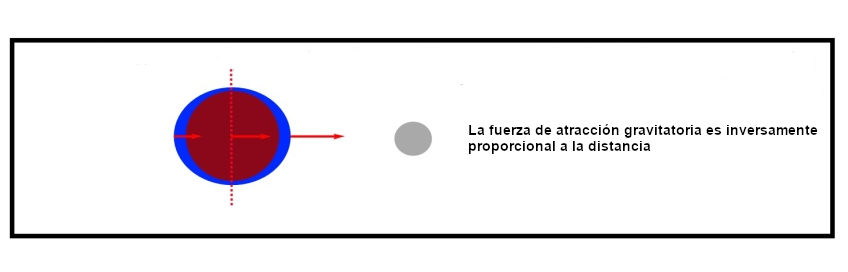
This bulge follows the Moon, producing friction with the solid surface of our planet. This results in a slowing down of the Earth’s rotation, increasing the length of the day. Due to the conservation of angular momentum, the orbital motion of our satellite is accelerated, causing it to gradually move away from our planet.
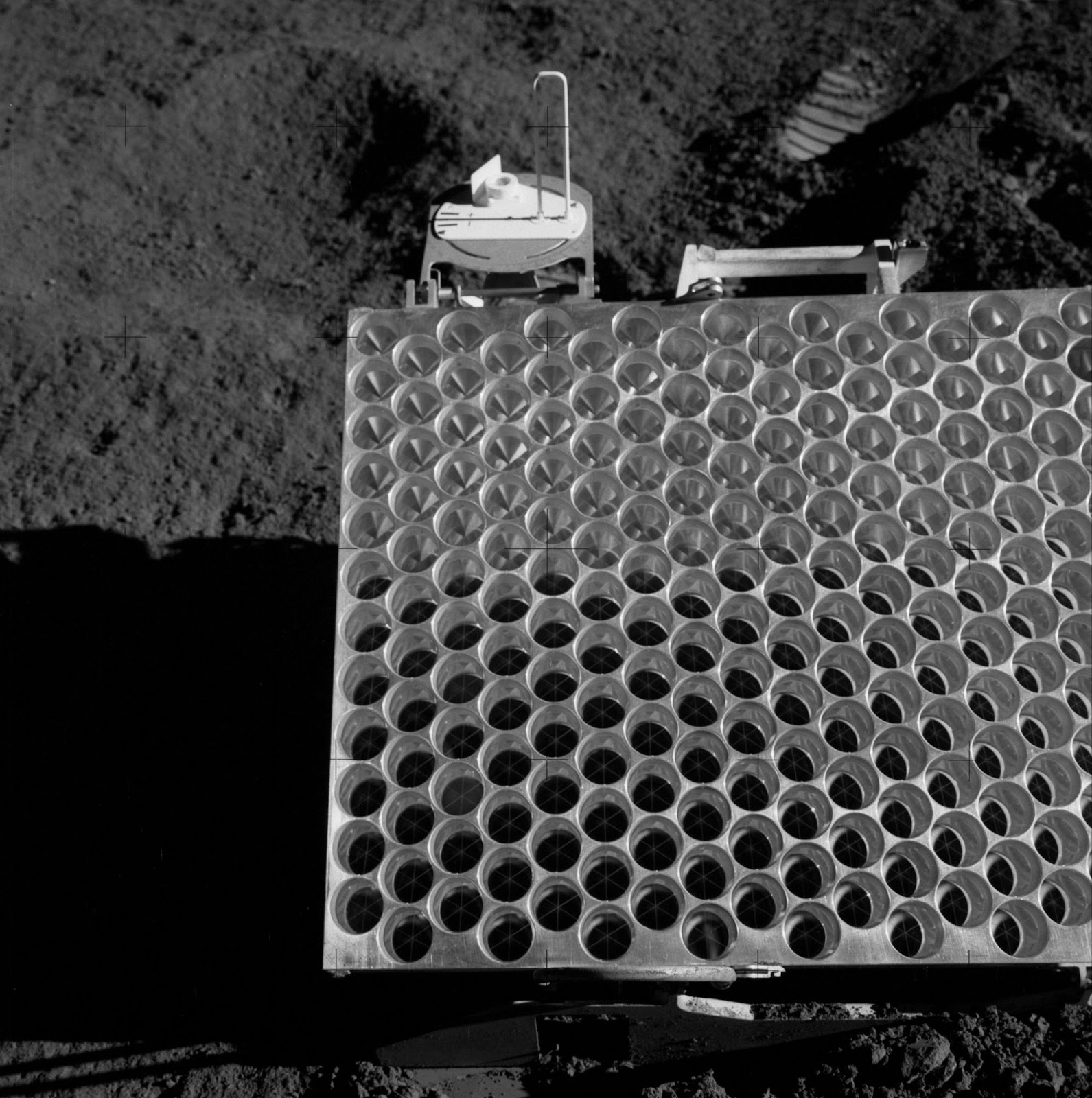
As it moves away, the Moon’s apparent size becomes progressively smaller, and a time will come when it will no longer be sufficient to completely cover the solar disc at any point in its orbit, making total solar eclipses impossible. Fortunately, this is not something to worry about in the near future, as the process is extremely slow. Thanks to the mirrors left on the Moon by the Apollo missions, we can accurately measure the distance to our satellite by firing lasers at them and timing their return. Current measurements indicate that the Moon is receding at a rate of about 3.8 cm per year.
If this rate of separation were to remain constant over time—which is unlikely—we would still have around 600 million years during which we could enjoy this phenomenon. However, as the Moon moves further away from our planet, the intensity of the tides will decrease, as will the friction they produce, causing the rate of recession to slow down. Calculations therefore indicate that total solar eclipses will remain observable for more than 1 billion years.