The moment of totality
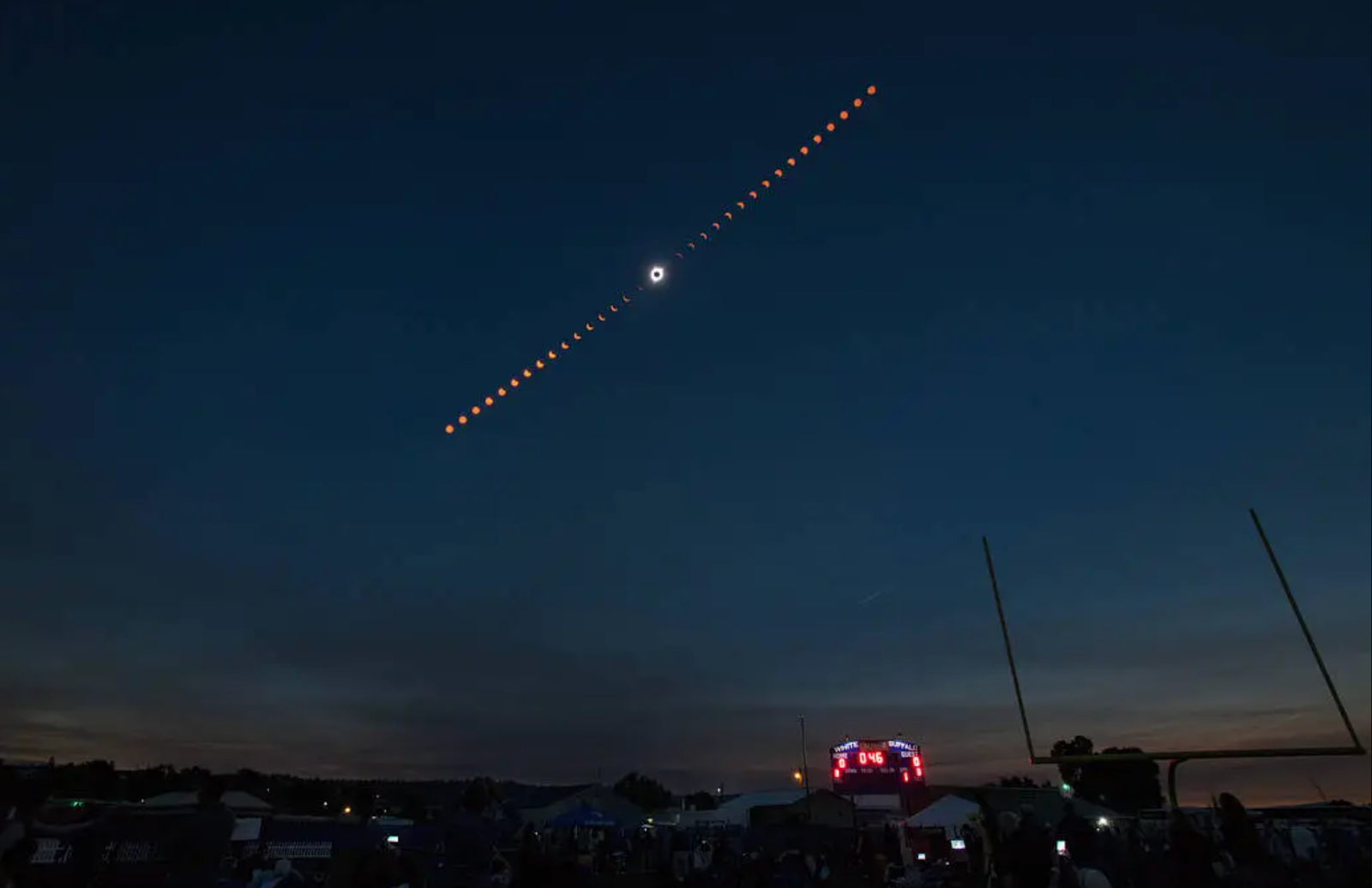
A total solar eclipse is one of the most impressive spectacles that nature can offer, and in the coming years we will have the good fortune to witness two of them, as well as an annular one. But what will we see when we are faced with one of these phenomena? In a total eclipse we will experience a progressive sequence, in which the lunar disc will gradually cover the solar disc until it completely obscures it. After a few seconds or minutes of totality, we will then observe the reverse process: the Moon will shift and gradually reveal the Sun again, until they no longer overlap and we once more see the full solar disc.
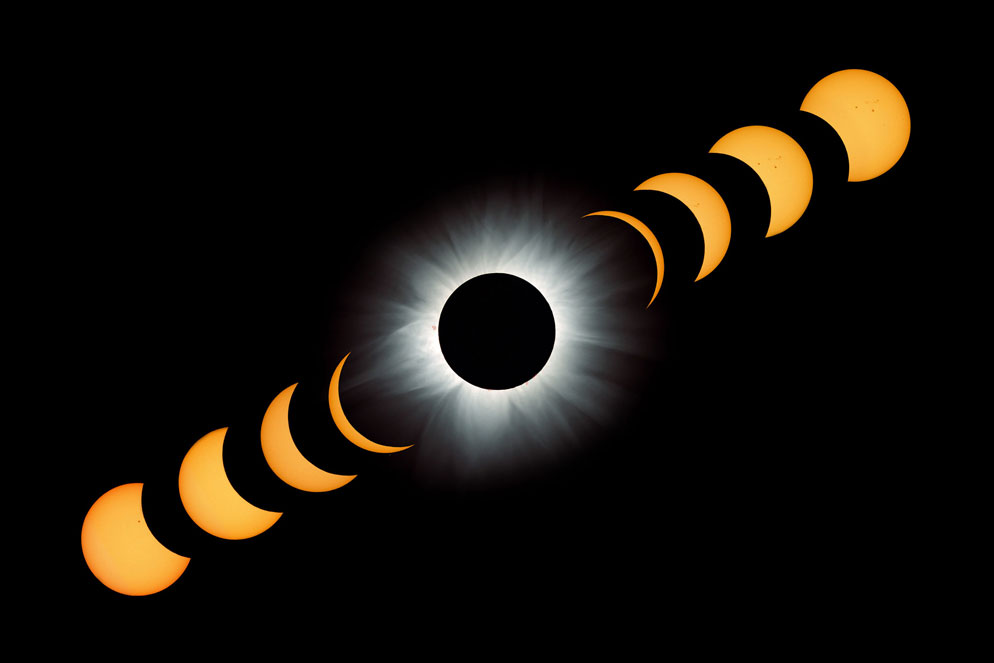
We can follow the sequence of the eclipse step by step and see what each of its phases has in store for us. First we have what is known as the first contact (one of a total of four instants referred to in this way throughout the phenomenon), which occurs when the lunar disc “touches” and begins to overlap the Sun’s disc. There is no actual contact; the word refers to our perception when observing the two discs in the sky. Until the first contact occurs, the Moon, although it may be next to the Sun, will be completely imperceptible to us as observers. It is a new Moon, of which we only see the shadowed side, and the Sun’s brightness is so intense that we perceive nothing of this body until its presence becomes evident in the eclipse.
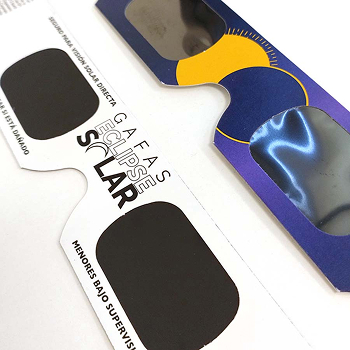
From the moment of first contact, the first partial phase of the eclipse begins, during which the Moon progressively conceals an ever larger percentage of the Sun’s surface. This lasts several tens of minutes. It is very important to emphasise that during the partial eclipse, even though sunlight may gradually diminish, the Sun must never be looked at directly or without adequate protection (see the section How to observe eclipses). The reduction in sunlight that occurs during a partial eclipse with high obscuration can make us complacent because looking at the Sun feels less uncomfortable, but the radiation emitted even by a small part of the Sun’s surface is already dangerous for our eyesight.
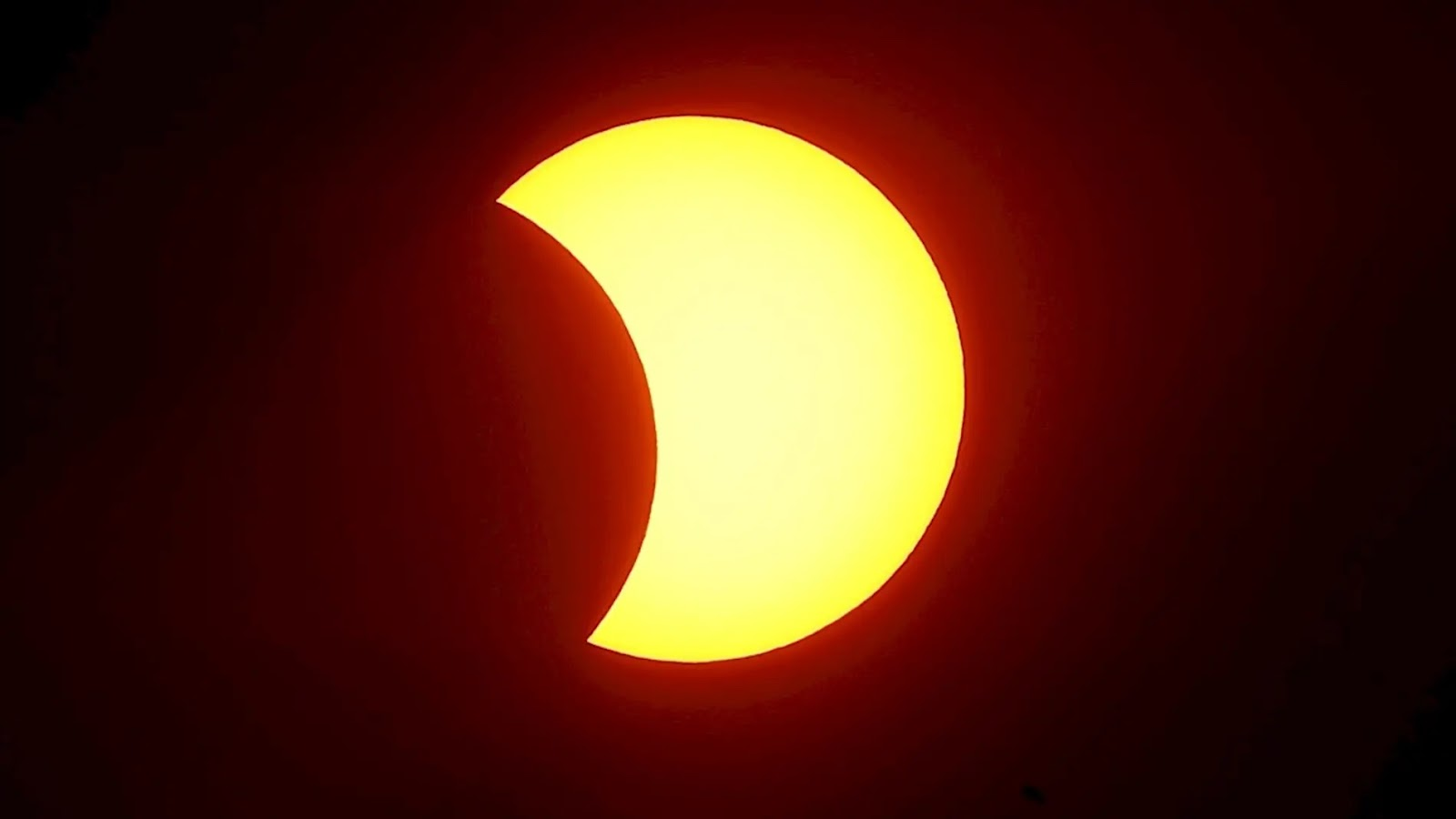
The Moon will continue to cover more and more of the Sun until it has almost completely obscured it. The final moments of the partial phase bring with them some interesting details. When the Moon has almost fully interposed itself in front of the solar disc, only a thin rim of sunlight will remain at the edge of the disc. A few seconds before total obscuration, an effect known as the “diamond ring” will appear. A faint glow will already be visible around the remaining eclipsed Sun–Moon disc, and there will be a final fragment of direct sunlight in a small area, recalling the image of a ring set with a very bright diamond.
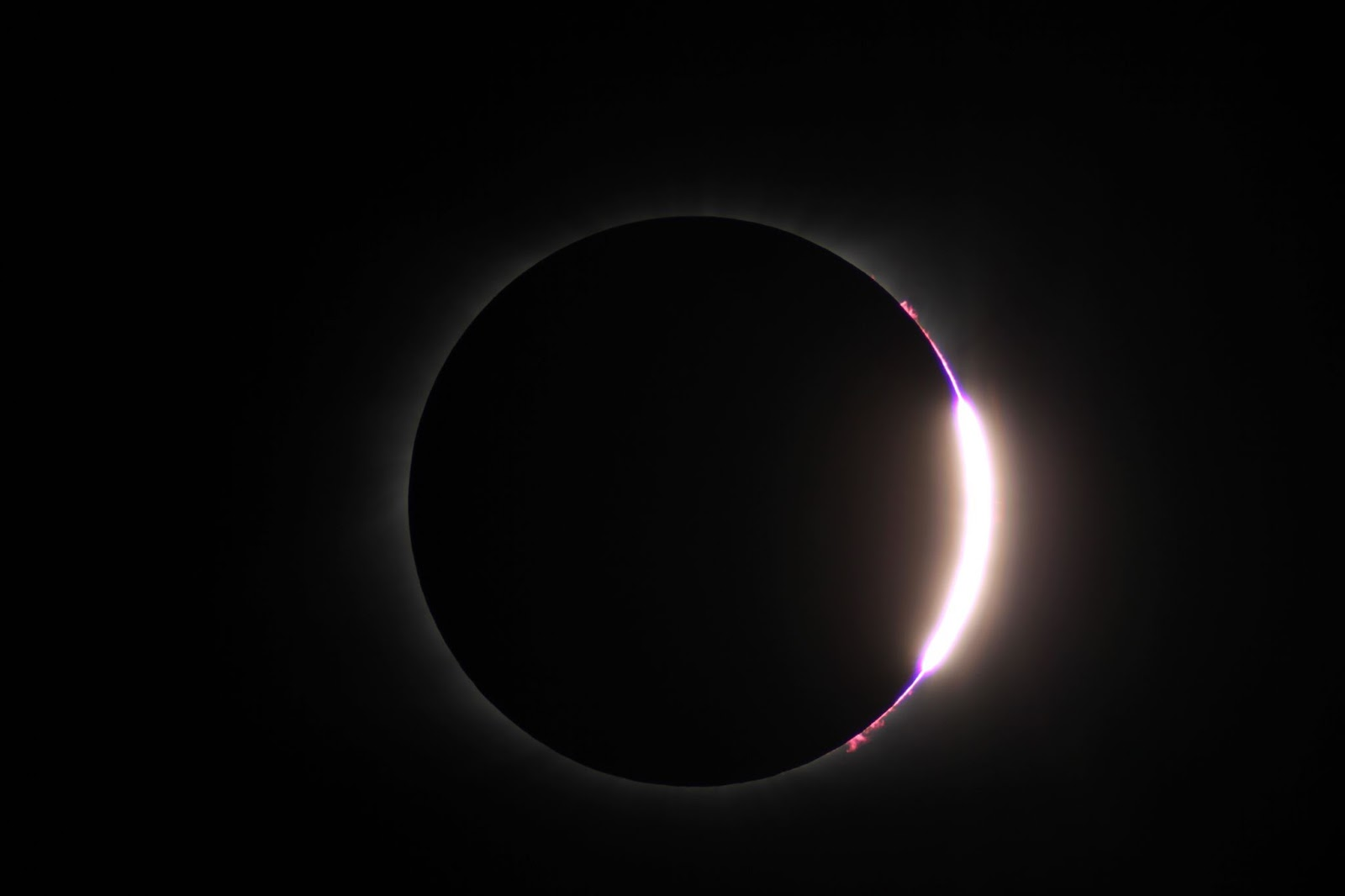
Just a few seconds later, immediately before total obscuration, we will still see small fragments of solar light, which will no longer form a continuous line but will instead resemble a string of beads of light. These are known as Baily’s beads, named after the British astronomer Francis Baily, who first described them during the solar eclipse of 1836. These beads of light occur because the Moon is not a smooth sphere but has relief, such as mountains, craters and valleys. The last intense sunlight we receive is that which filters through the gaps in this relief along the edge of the lunar disc. In addition to producing a beautiful visual effect, these beads of light have had significant scientific value for the study of the Moon’s topography. As we now know the lunar surface very well, we can predict in advance how Baily’s beads will appear in a specific solar eclipse.
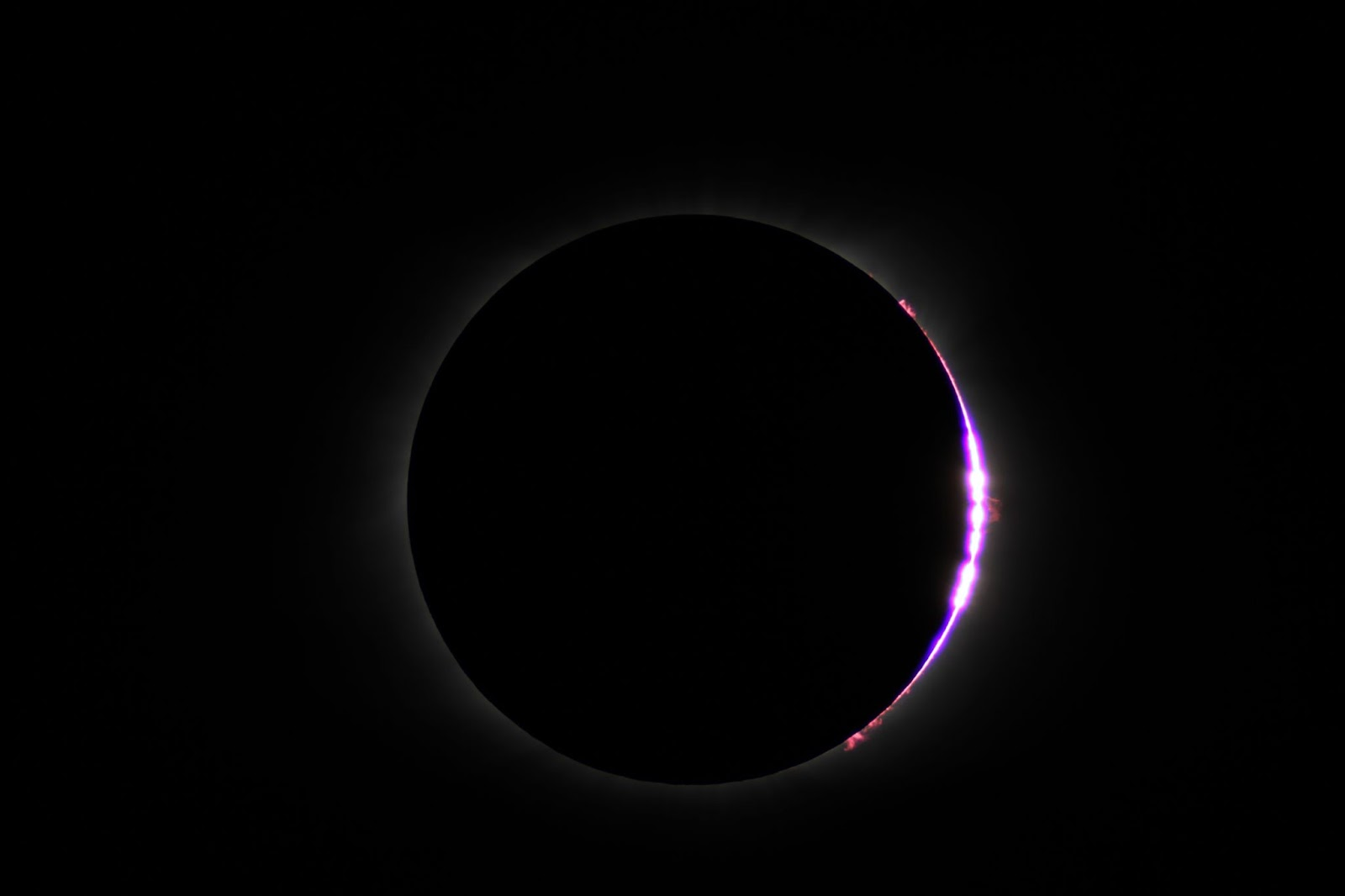
And now, totality arrives. The Moon completely conceals the Sun, a situation that will last from a few seconds to a few minutes, depending on the eclipse and the observer’s location within the corresponding path of totality. During this phase, what we will see is a dark circle, which is in fact the shadowed face of the Moon, surrounded by a halo of faint light. This is the only phase of a solar eclipse during which we can look at the Sun without eclipse glasses or certified protection, but great care must be taken not to do so until we are certain that the obscuration is complete, and to stop looking before it ends.
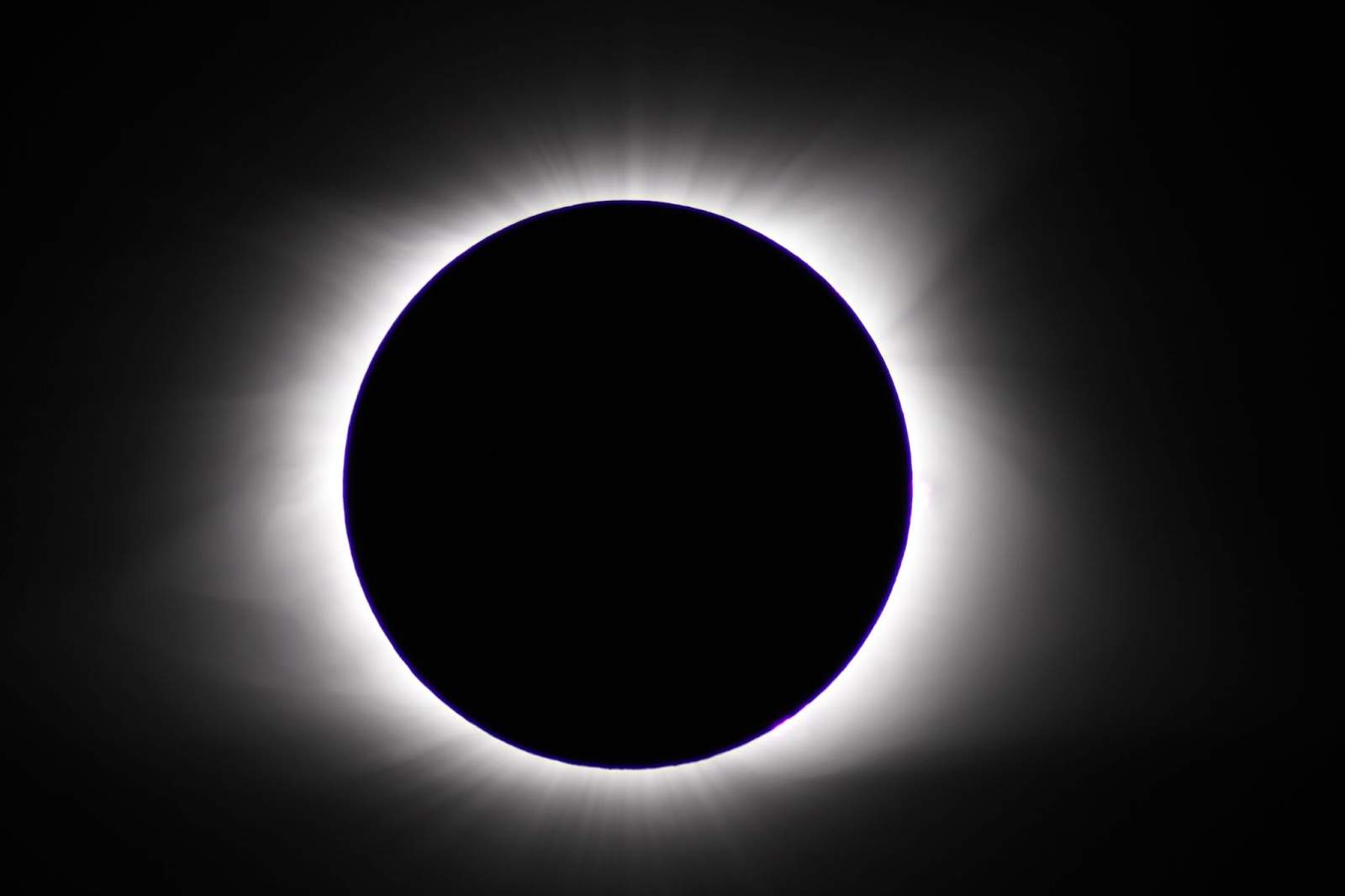
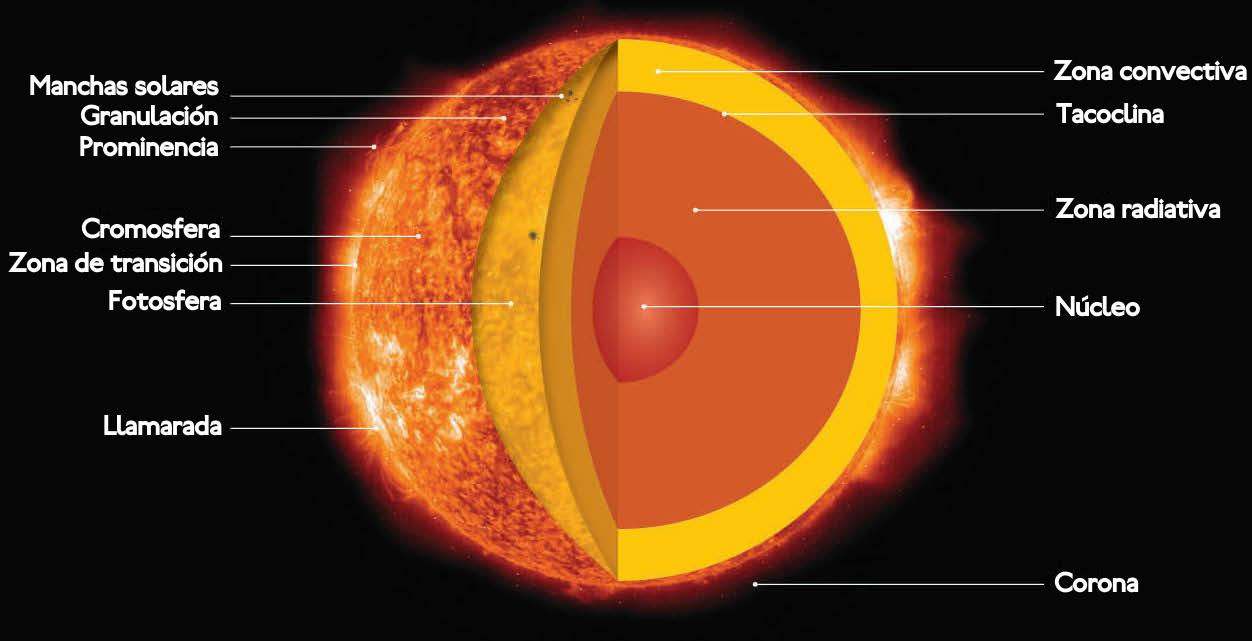
What are we seeing during the phase of totality? To understand this, we need to consider our star as a whole and remember that, as explained in more detail in the section “The science of eclipses”, the Sun is a large sphere of gas composed mainly of hydrogen and helium. The layer we consider the surface of the Sun is called the photosphere, and it emits most of the light we normally observe. Above it, however, are two further layers, the chromosphere and the corona, which together form what we can call the Sun’s atmosphere. The reddish or pinkish regions seen in images such as those of the diamond ring or Baily’s beads belong to the chromosphere and are due to the emission of hydrogen in this layer. The halo of light that we see around the dark disc during a total eclipse corresponds to emission from the solar corona. The corona emits so faintly, due to its low density, that under normal conditions it is impossible to see, as its brightness is imperceptible compared with that of the photosphere. This changes, however, during the very special moments of totality in a solar eclipse. In this case, the Moon blocks all the emission from the photosphere, and in return the brightness of the corona becomes visible as a spectacular halo.
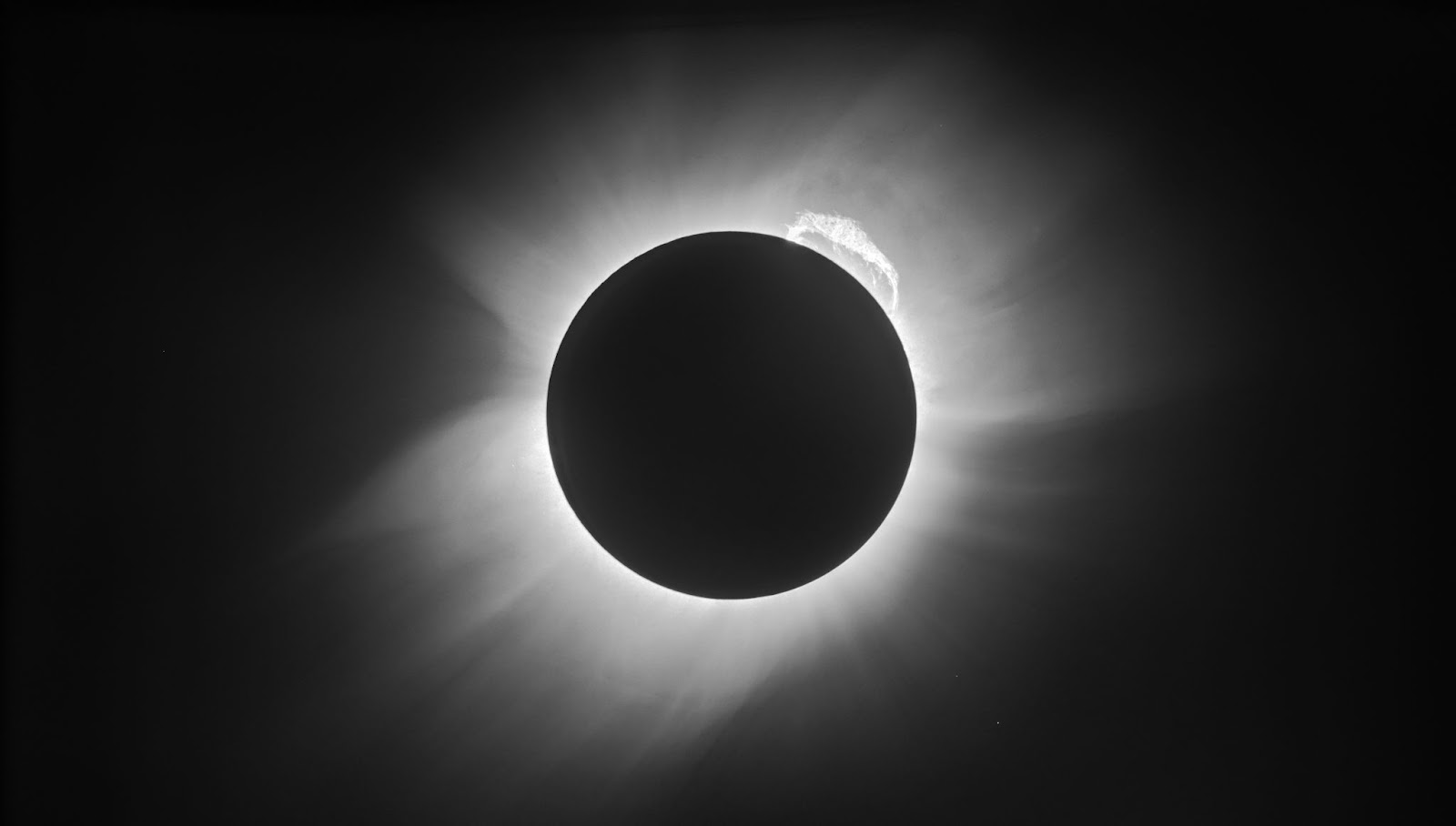
Total solar eclipses are a great opportunity to see and study emission from the mysterious corona, but they also allow us to observe other phenomena that take place in the outermost layers of the Sun. We are referring to solar eruptions or flares, large explosions that occur in certain regions of the solar atmosphere when large amounts of energy are released by magnetic phenomena in the Sun, and which are also explained in more detail in the section “The science of eclipses”. Total solar eclipses are the only natural opportunity we have to directly observe, using suitable telescopes and cameras, the arched structures or emissions produced by these impressive atmospheric phenomena of the Sun.
The phase of totality lasts from a few seconds to a few minutes. When it comes to an end, we reach what is known as the third contact, the moment when the lunar disc, as it moves along its path, begins to uncover the Sun’s disc. From then on, we experience in reverse the entire process that led us to totality: we will once again see Baily’s beads and the diamond ring, with the pinkish emission of the chromosphere, and then witness the entire partial phase, during which the Moon will gradually cease to cover the Sun. The eclipse ends with the fourth contact, the final instant in which we see the Moon and the Sun overlapping in the sky. After that moment, the Moon, which has gifted us this incredible spectacle, becomes invisible to us once again, and the Sun shines round and complete with all its strength.
Moments of darkness
We have described what we can see during a total eclipse when observing the Sun (with the necessary protection for our eyesight), but the spectacle will not be limited to our star alone, it will also unfold around us. During the partial phase, the intensity of sunlight will remain very high, so it will still be broad daylight, but it will be worth observing, for example, the differences in the shadows cast by sunlight filtering through the leaves of trees. The most striking moment comes with the onset of totality, when there is a very abrupt decrease in sunlight. It will not be exactly like nightfall, but rather like a very late sunset, just on the verge of darkness. We will also notice a sudden drop in temperature, all within the space of just a few seconds. Where the Sun formerly shone, we will now see the dark disc of the Moon surrounded by the halo of the solar corona, and elsewhere in the sky some of the brightest stars will appear, which until then had been invisible due to daylight.