12 August 2026
Solar Total Eclipse
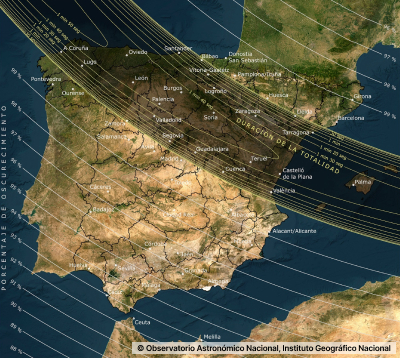
During the evening of Wednesday, 12 August 2026, the first total solar eclipse visible from the Iberian Peninsula in more than a century will take place.
A solar eclipse is the phenomenon whereby the light of the Sun is totally or partially obscured when a celestial body comes between the Sun and the observer. In solar eclipses as seen from Earth, the body that obscures the Sun is the Moon.
From the observer’s point of view, solar eclipses are classified as total, annular and partial. An observer will say they have witnessed a total eclipse when they see the Moon completely cover the disc of the Sun. However, another observer located hundreds of kilometres further north or south will see the Moon cover only part of the Sun, and for them the eclipse will be partial. There are occasions when the Moon does not fully cover the Sun from any point on Earth, meaning that for all observers the eclipse is partial.
Another common type of eclipse is the annular eclipse. These occur when the observer sees that the disc of the Moon does not completely cover the disc of the Sun, even though their centres are well aligned. This is because on that day the Moon is farther from the Earth than in the case of a total eclipse, so its disc appears smaller than that of the Sun. In this situation, a bright ring surrounding the lunar disc is observed.
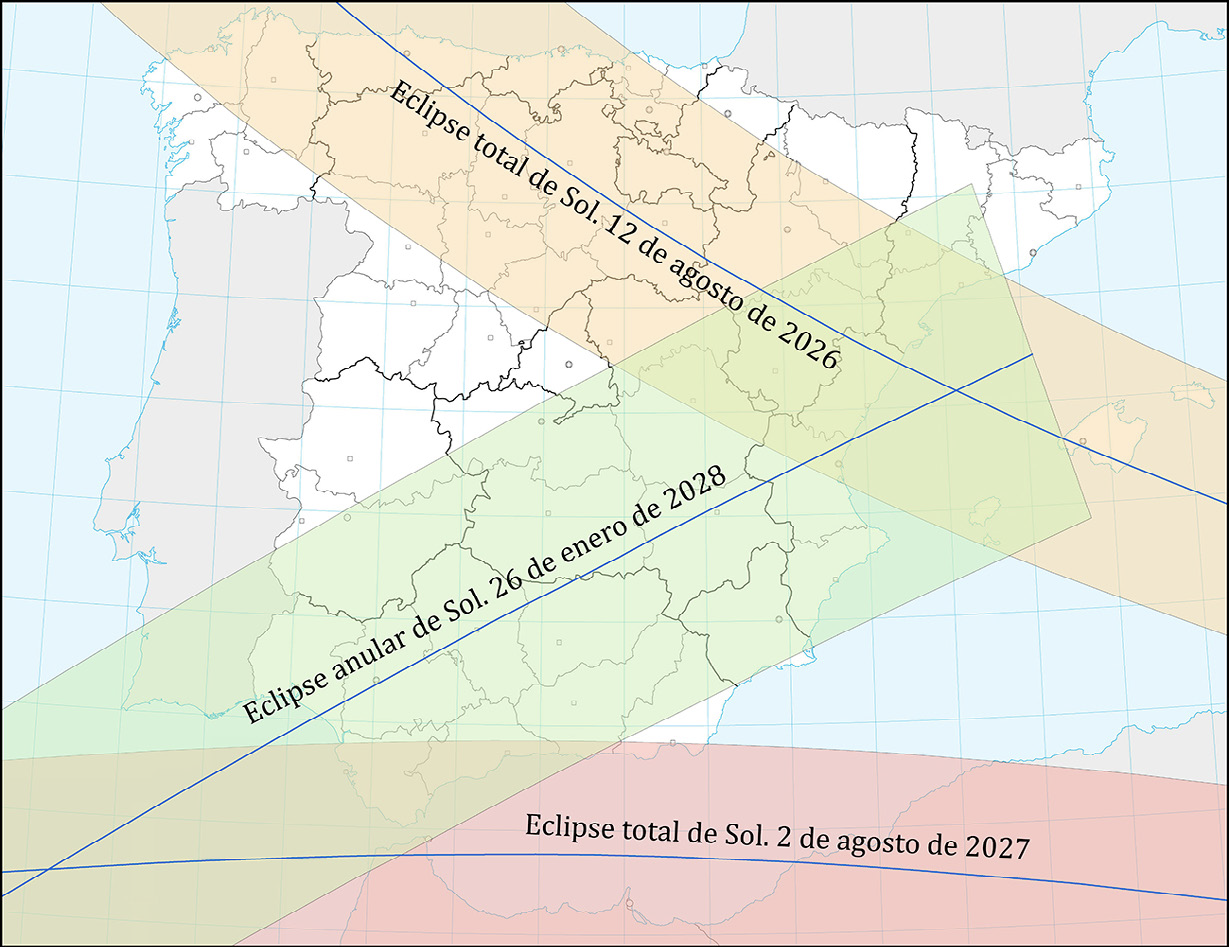
Although it is common to be able to observe a partial solar eclipse every few years from the same location, witnessing a total or annular eclipse is much less frequent. In Spain, the last visible annular eclipse occurred in 2005, and the last total eclipse was seen in 1959, and only from the Canary Islands; from the Iberian Peninsula, no total solar eclipse had been seen since 1912. This eclipse drought will soon come to a spectacular end, as between 2026 and 2028 there will be two total eclipses and one annular eclipse visible from some part of our country.
The first total solar eclipse to be visible on the Iberian Peninsula in more than a century will take place on 12 August 2026. The path of totality will cross Spain from west to east and pass through numerous provincial capitals, from A Coruña to Palma de Mallorca, including León, Bilbao, Zaragoza and Valencia. Our country lies at the end of the path of totality, so the event will occur as the Sun is setting very close to the horizon, making it advisable to observe the eclipse from a location with a clear view towards the west.
Almost a year later, on 2 August 2027, another total eclipse will cross Spain. The path of totality will pass through the Strait of Gibraltar from west to east and cover the extreme south of the Peninsula and northern Africa, including cities such as Cádiz, Málaga, Ceuta and Melilla. The eclipse will occur during the morning, and the maximum duration of totality will be observed in Ceuta, lasting 4 minutes and 48 seconds.
Finally, on 26 January 2028, an annular eclipse will occur, with the path of annularity crossing the Peninsula from south-west to north-east shortly before sunset, including cities such as Seville, Málaga, Murcia and Valencia, where the annular phase will be fully visible. In Palma de Mallorca and Barcelona, only the beginning of the annular phase will be visible, as the Sun will set before it ends. Due to the low elevation of the Sun above the horizon, observing this eclipse will require excellent visibility in the direction of sunset.
We will therefore enjoy not one, but three very special opportunities to observe one of the most impressive spectacles that nature offers us. On this website we provide detailed information on each of this exceptional trio of eclipses, as well as all the resources needed to understand and enjoy these phenomena to their fullest.
During the evening of Wednesday, 12 August 2026, the first total solar eclipse visible from the Iberian Peninsula in more than a century will take place.
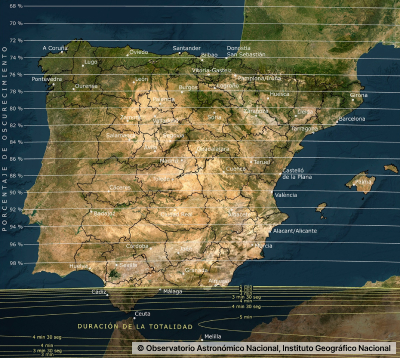
Continuing the sequence of the three Iberian eclipses, on 2 August 2027 a new total solar eclipse will take place, visible from the Iberian Peninsula.
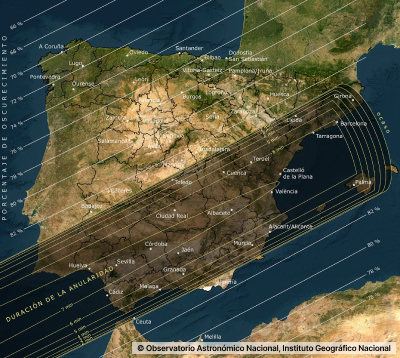
Following the two total eclipses of the previous years, on 26 January 2028 a new solar eclipse will take place, this time annular, visible from Spain.
Explore and discover more information to enjoy this celestial phenomenon
What is an eclipse

How to observe eclipses
Protect your eyes

What can be seen during a total eclipse

Curiosities and future eclipses
Viewing conditions from each location

Practical recommendations

Meteorological information

Astrophotography

Eclipses for children
Resources for teachers
The science of eclipses

Eclipses in history
Eclipses in art and mythology